
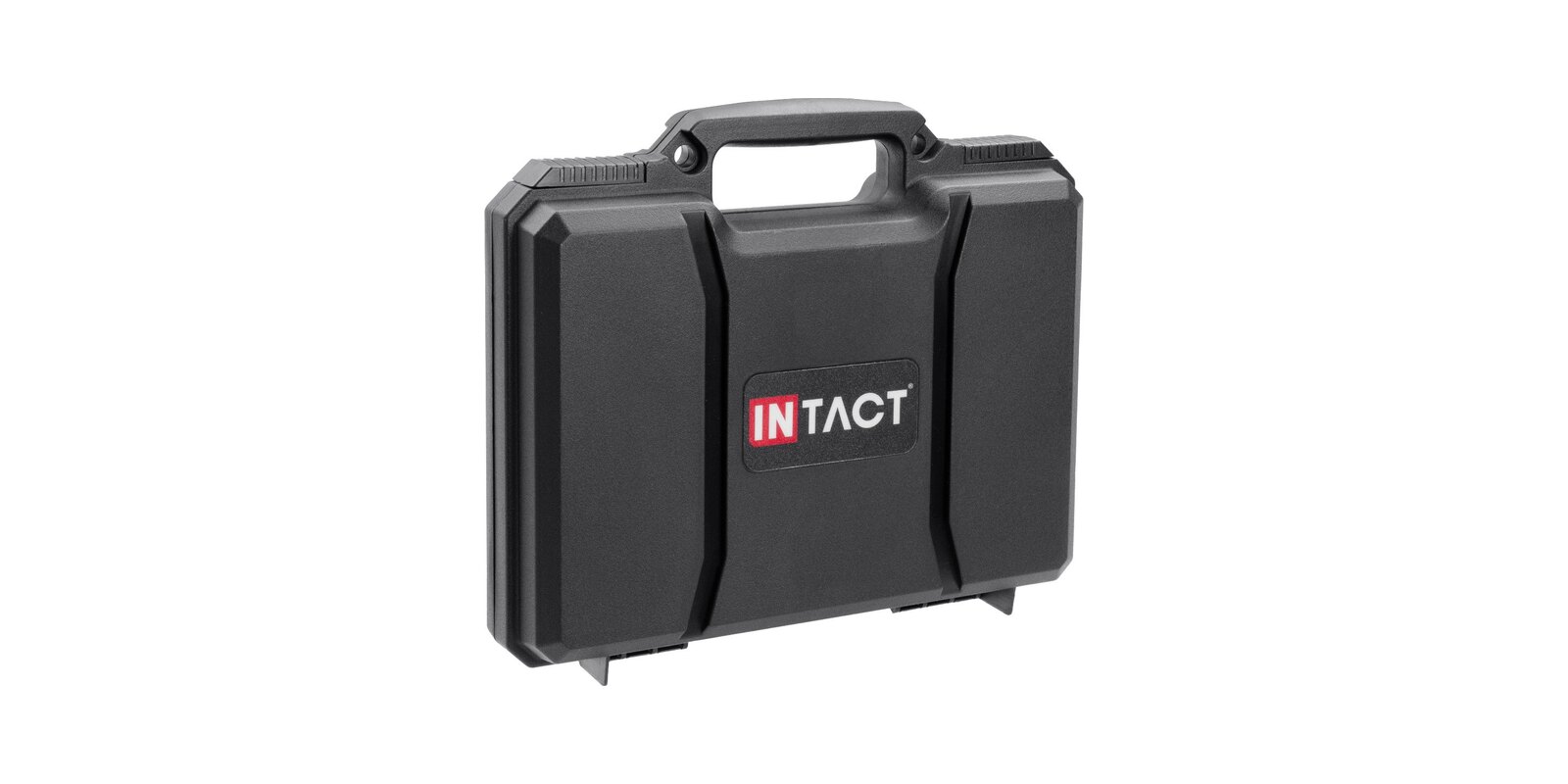
Interior dimensions, foam depth and optic clearance for a Glock 19, 17, 43X or 34 — plus how to lock a pistol case for a flight and what to buy for the range, bedside or checked baggage.
A Glock case needs interior dimensions at least 2 inches longer and wider than the pistol itself: roughly 9 x 7 inches for a Glock 19, closer to 11 x 8 inches for a Glock 34, and about 3 inches of depth once foam sits above and below the gun. Add an inch of width for a red dot.
Almost every listing for a pistol case tells you the outside dimensions. The outside is not what matters. What matters is the usable space inside the foam once your optic, light and spare magazines are in there. Here is how to work it out before you buy.
What interior dimensions fit a Glock 19, 17, 43X or 34?
Lay the pistol on its side in the case. Three measurements decide whether the lid closes:
- Overall length (muzzle to back of slide) sets the case’s interior length.
- Height with the magazine seated (baseplate to top of the sights or optic) sets the interior width.
- Width (widest point — usually the slide stop, mag release or a weapon light) sets how much interior depth you need.
Measure your own pistol with a tape or calipers — sights, baseplates and generations vary. The numbers below are approximate and only meant as a starting point.
| Model | Approx. length | Approx. height (flush mag) | Minimum interior footprint |
|---|---|---|---|
| Glock 43X / 48 | ~6.5 in | ~5.0 in | 8.5 x 7 in |
| Glock 19 / 45 | ~7.3 in | ~5.0 in | 9.3 x 7 in |
| Glock 17 / 22 | ~8.0 in | Just over 5 in | 10 x 8 in |
| Glock 34 / 35 (long slide) | ~8.8 in | Just over 5 in | 11 x 8 in |
The “minimum interior footprint” column already includes roughly an inch of foam wall on each end and side. Foam thinner than that tears at the corners and lets the pistol shift. If you also want magazines or ammo beside the gun, add their footprint on top of those numbers.
For reference, the Eylar® 11.7″ Intact Stacker Series hard handgun case has an 11.61″ x 8.46″ x 3.15″ interior. That clears a Glock 34 lengthwise with room left over for mags, and it still holds a 43X without the pistol rattling once the foam is cut to shape.
How much room do a red dot, weapon light and extended mag add?
This is where most people buy the wrong size. Accessories don’t grow the pistol evenly — each one grows a different axis.
| Accessory | Which dimension it grows | Typical extra space to plan for |
|---|---|---|
| Red dot / enclosed optic | Height (case width) | About an inch above the slide |
| Suppressor-height sights | Height (case width) | A fraction of an inch above stock sights |
| Weapon light | Width (case depth), sometimes length | Becomes the widest point of the gun; may pass the muzzle on a compact |
| Extended or +2 magazine | Height (case width) | Up to about an inch below the grip |
| Threaded barrel / compensator | Length | Half an inch to an inch and a half |
| Magwell or grip extension | Height and width | A fraction of an inch each |
A Glock 19 with a red dot and a light is a bigger object in every direction than the bare pistol — taller at the optic, wider at the light, sometimes longer at the muzzle. Measure the gun as it will be stored: optic mounted, with the magazine you actually keep in it.
How much foam do you need above and below the pistol?
Depth is the dimension people forget, and it is the one that leaves the lid foam pressing on your optic. A workable stack looks like this:
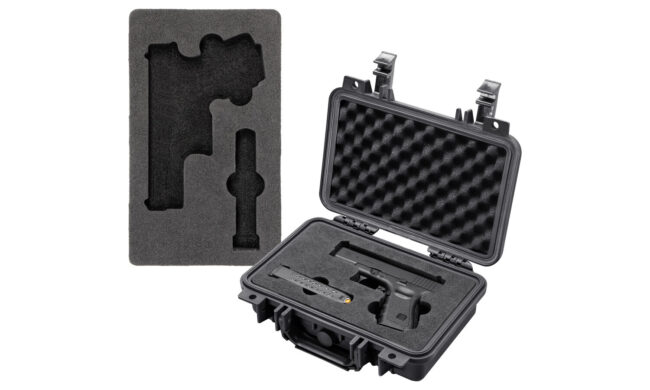
- Base layer: a half inch or so of solid foam under the pistol so nothing bottoms out against the shell.
- Pistol layer: at least as thick as the widest point of the gun, measured with the light mounted.
- Lid foam: convoluted (egg-crate) foam that touches the pistol with light, even pressure.
On most pistol cases that adds up to roughly 3 inches of interior depth. The lid foam should contact the slide and frame, not press down on the optic housing. If you have to lean on the lid to latch it, the cavity is too shallow — remove another layer under the gun instead of forcing the lid.
A quick check: close the case with a strip of paper under the lid foam over the optic. If the paper slides out freely, there is no contact at all and the gun can move. If it will not budge, you are loading the optic. Light drag is right.
How many magazines and accessories actually fit?
A loaded Glock magazine is a little over 5 inches tall, about a half inch thick and roughly an inch front to back. Laid flat beside the pistol in an 8.46-inch-wide interior, you can plan on:
- 2 to 3 spare magazines stacked along one long edge, or
- 1 magazine plus a small cleaning kit and a chamber flag, or
- 4 or more magazines if you skip the cleaning kit and cut mag slots into the base layer rather than the pistol layer.
Two ways to get the layout you want:
Precision-cut insert. The 10.5″ Glock 19 and 1 mag foam insert is cut to shape at 10.5″ x 6.25″ x 2″ in crosslink foam and drops into the Eylar SA00010 case. No knife work, and the cavity holds the pistol plus one magazine without slop.
Pick-and-pluck. Standard Eylar hard cases ship with three layers: egg-crate lid foam, a pluckable middle layer and a solid base. Trace the pistol with a marker, pull the cubes, and leave a one-cube border so the walls stay rigid.
Do Glocks come with a case, and is a Glock case TSA approved?
New pistols usually ship in a molded plastic factory box with a lock hole or two. It protects the gun in the shipping carton. It is not built for being thrown into a baggage system, soaked on a tailgate or stacked under other gear.
On the TSA question: there is no such thing as a TSA-certified firearm case. TSA does not certify cases. The rule for checked firearms is simpler and stricter than people expect:
- The firearm must be unloaded.
- It must be in a locked, hard-sided container.
- You must declare it at the airline counter at check-in.
- Only you may hold the key or combination. A travel-type lock that security can open with a master key is the wrong choice here — use your own padlocks.
- Ammunition travels in packaging designed for ammunition, per your airline’s rules.
Airlines can also refuse a container that flexes open at the corners when squeezed. That is the practical failure point of a thin factory box. A rigid polypropylene case with padlock-adaptable fittings on both sides of the lid passes that squeeze test, and the Intact Stacker has two padlock mounting points for exactly that. Many Eylar hard cases are also IP67-rated and fitted with an automatic pressure-equalization valve for cargo holds, but those features vary by model, so read the specification for the case you are buying. Confirm current rules with TSA and your airline before you leave.
Which Glock case should you buy for the range, bedside or flying?
The three jobs pull in different directions, and one case rarely does all three well.
| Use | What matters most | What to look for |
|---|---|---|
| Range and truck | Light weight, fast access, stacking | Compact hard case with convoluted foam top and bottom, center handle, cases that stack together |
| Bedside / home storage | Fast, repeatable access plus access control | A biometric safe, mounted or anchored, not a carry case |
| Checked baggage | Rigidity and lockability | Hard-sided shell, two padlock points, gasket seal, pressure valve, your own non-master-keyed padlocks |
For range and transport, a compact hard case in the 11-inch class covers every Glock model, long slides included. The Intact Stacker weighs about a pound, has a center handle, is built from reinforced high-pressure polypropylene, stacks with other Intact Stacker Series cases, and comes in black, dark earth, gray and tan. Other sizes and layouts are in the compact gun cases range.
For bedside storage, a carry case with padlocks is the wrong tool — you want a fixed container with controlled access. Look at biometric safes for that role, and keep the hard case for the drive to the range.
FAQ
How do you lock a Glock case for a flight?
Run a padlock through each of the case’s padlock mounting points so the lid is secured on both sides rather than at one corner. Use locks only you can open — not a master-keyed travel lock, because airline rules require the passenger to keep the key. Declare the unloaded firearm at the counter and keep the case within your control until it is tagged.
Will one case hold two Glocks?
Often, but only if you nest them. Two compacts laid side by side need about 10 inches of width, which is more than an 11.61″ x 8.46″ interior gives you, so turn one muzzle-left and one muzzle-right with the grips offset. Draw the interior size on a sheet of paper, lay both pistols on it and check before you cut foam. Keep at least an inch of foam between the two cavities, and expect to give up most of the spare-magazine space. Reconfigurable blocks make this layout easy to change back.
Does a Glock case need to be waterproof?
For a case that lives in a truck bed, on a boat or in checked baggage, a gasket seal matters more than people expect — dust and condensation start rust long before a case ever gets dunked. Many Eylar hard cases carry an IP67 rating and a pressure-equalization valve, though the rating varies by model, so check the listing. For a case that only travels from the closet to the range bench, a snug foam fit does more for the gun than the seal does.
