

Interior dimensions, empty weights, a packing checklist and honest advice on where the box should ride — how to choose a sealed, roto-molded recovery gear storage box that actually fits your kit.
A recovery gear storage box should be a sealed, roto-molded case that holds wet straps, shackles and a shovel without tipping or leaking into your cargo area. Eylar® crossover cargo cases do that job: one-piece LLDPE shells, weatherproof gaskets, integrated lockable points, and cases that stack and mount to a roof rack.
The hard part is sizing it against your real kit and packing it so everything is reachable when you are stuck in the dark.
What size recovery gear storage box do you need?
Most people buy one size too small, then end up with a shovel handle sticking out of the lid and a strap bag riding loose on the back seat. Size the box around your two bulkiest items — usually the shovel and the compressor — then fill the rest of the space with small, heavy hardware.
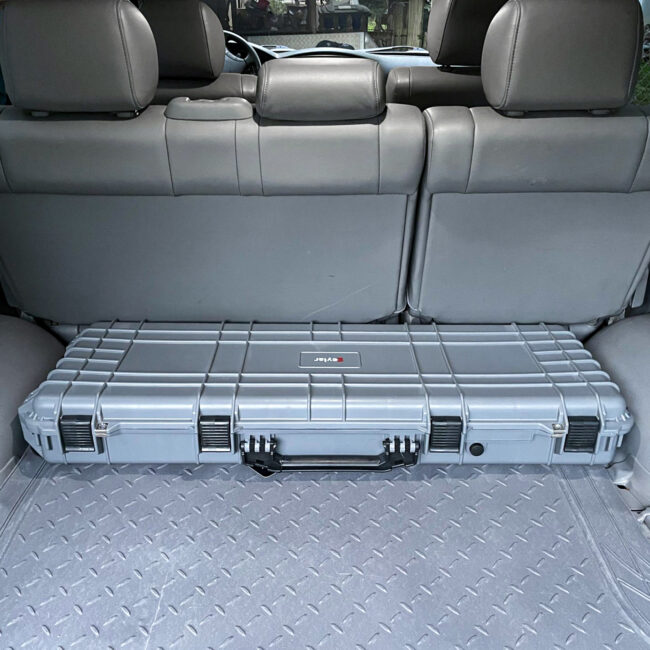
Interior dimensions are the only numbers that matter. A case that measures 25.6 inches outside gives you about 21.9 inches inside, and a full-size shovel handle does not care about the difference.
| Case | Exterior | Interior | Empty weight | Colors in stock |
|---|---|---|---|---|
| SR-50 (50 L) | 25.6″ x 15.2″ x 13.75″ | 21.9″ x 11.25″ x 11.34″ | 18 lb | Green |
| SRX-50 (50 L) | 23.4″ x 18.3″ x 13.3″ | 18.7″ x 13″ x 8.91″ | 20 lb | Black, Gray, Green, Tan |
| SRX-90 (90 L) | 32.7″ x 18.4″ x 14.6″ | 27.9″ x 13″ x 10″ | 27.2 lb | Black, Gray, Green, Tan |
| SRC-160 (38-inch) | 37.8″ x 22.8″ x 17.8″ | 36″ x 20.9″ x 14″ | 35 lb | Black, Gray, Green, Tan |
| SRX-110 (110 L) | 47.2″ x 18.4″ x 13.2″ | 42.5″ x 12.7″ x 8.5″ | 37.5 lb | Black, Gray, Green, Tan |
All five are one-piece roto-molded LLDPE with a weatherproof gasket, rated IP4 water resistant, stackable and roof-rack mountable.
How to read that table for a recovery kit:
- Rope, shackles, gloves, air tools and a folding shovel: the SR-50 50L Crossover Overland Cargo Case handles that, and 11.34 inches of interior depth leaves room for a coiled kinetic rope.
- Deeper kit with a snatch block and jack accessories: step up to the SRX-90 90-liter case and its 27.9″ x 13″ x 10″ interior.
- Long-handled shovel or pry bar: the SRX-110 at 42.5 inches inside is the one that takes length, but it is only 8.5 inches deep, so bulky items still need another box.
- One box for recovery plus camp tools: the SRC-160 holds the most, with a 36″ x 20.9″ x 14″ interior.
Watch empty weight too. These cases weigh 18 to 37.5 lb before you load them, and that counts against your roof rack’s rating.
What should go in a vehicle recovery kit box?
Build the kit around one rule: everything needed to get the vehicle unstuck lives in one box, and nothing else does. If you have to dig past a tent bag to reach a shackle, you packed it wrong.
- Kinetic recovery rope or tow strap — bagged or rolled, kept away from sharp edges
- Tree saver strap and a spare extension strap
- Soft shackles and rated bow shackles — heaviest small items, so they ride on the bottom
- Snatch block or pulley if you run a winch
- Winch line damper (folds flat, doubles as a kneeling pad)
- Heavy gloves — two pairs, one pair never leaves the box
- Folding shovel or short-handled spade
- Tire deflator, gauge and a plug kit
- Compressor with its hose coiled and secured
- Jack accessories — base plate, lift mate
- Work light or headlamp with fresh batteries
- Trash bags for muddy gear on the way home
Recovery boards are the common exception. Most run longer than even the 42.5-inch interior of the SRX-110, so mount them on the rack or the bed rails and keep the box for everything else.
How do you keep gear from sliding around inside the box?
Loose gear in a hard case does two things you do not want: it rattles for hours of washboard road, and it piles into one corner the first time you hit a rut. Three fixes, simplest first.
1. Bag it by job
Straps in one bag, shackles and hardware in a second, air tools in a third. Three stuffed bags packed tight against each other will not shift. This is the simplest fix and it works.
2. Cut foam for the hard items
Compressors, gauges, lights and radios survive better in foam than in a bag. Standard Eylar hard cases ship with three-layer foam — egg-crate lid foam, a pick-and-pluck middle layer and a solid base — so you can pull cubes to the shape of each tool. A cargo case is open volume, so getting that kind of layout means fitting an insert cut to the interior size.
3. Use reconfigurable foam if the kit keeps changing
Pick-and-pluck is permanent. Pluck a slot for a compressor, sell the compressor later, and the hole stays. RAGAR foam is Eylar’s reusable system made from XP crosslinked closed-cell foam (U.S. Patent No. 12,358,707); the blocks lift out and go back in, so the layout changes when the kit changes. If you are adding an insert to a case you already own, start with the guide to measuring a case for replacement foam so the first order fits.
One caution: foam and soaking-wet straps are a bad pair. Keep foam layouts for dry tools and electronics, and let the straps live in bags or in a separate box.
Where should the recovery box ride — bed, rack, or cargo area?
Recovery gear is heavy, and it is the last thing you want moving forward in a hard stop. Where it rides matters as much as what it is in.
| Location | Works well when | Watch out for |
|---|---|---|
| Truck bed, strapped to the front wall | Fast access, keeps mud out of the cab | Always strap or lock it down — a 50 L box packed heavy is a projectile |
| Roof rack | Frees up the bed; these cases are stackable and rack-mountable | Raises the center of gravity, and the case is 18–37.5 lb before you load it |
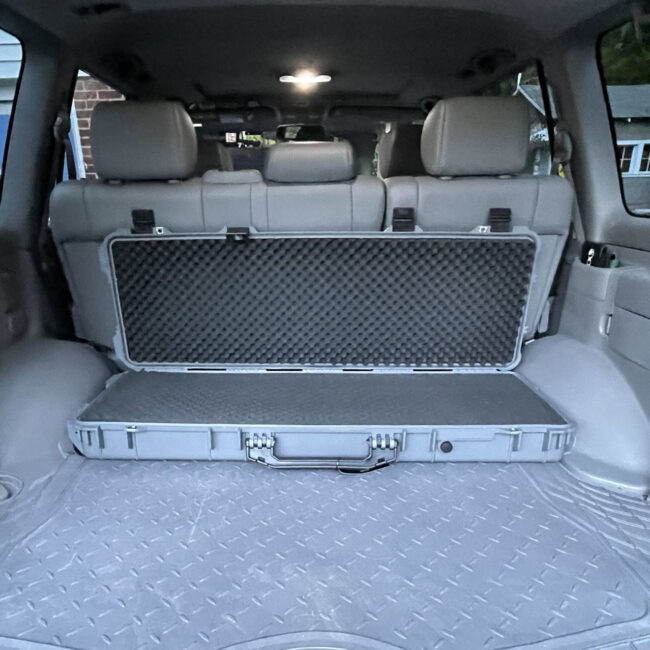
| SUV cargo area behind the seats | Weather protection, quiet ride, box stays clean | Wet, muddy gear ends up inside the cabin unless it is bagged |
| Trailer or chase rig | Group trips where one kit serves several vehicles | The box has to leave with the group, not stay with the trailer |
Every one of these cargo cases has integrated lockable points, which matters at trailhead stops and motel parking lots. A padlock will not stop someone determined, but it stops the casual grab, and that covers most of the risk.
How do you keep mud and water out?
Recovery gear is filthy by definition. The box has to handle weather outside and mess inside.
These cargo cases use a weatherproof gasket and a seamless roto-molded shell with no welds or seams to split or leak, and all are rated IP4 water resistant. Read that honestly: it is a water-resistance rating, not a waterproof one. Plan for rain and splashing, not submersion.
LLDPE will not rust or corrode the way a steel box does, and it holds its shape under load when another case is stacked on top. Habits that keep the inside livable:
- Rinse and wring out straps before they go back in — dried mud turns to grit, and grit cuts fibers.
- Line the bottom with a rubber mat. It catches sand and lifts out for a hose-down.
- Leave the lid cracked in the garage between trips so trapped moisture can escape.
- Keep one dry bag inside for gloves, batteries and anything electronic.
- Inspect straps and shackles every time you repack — that is the only time you will actually look at them.
Can the same case store tools, or a bow, instead?
Yes, and plenty of people run two cases for exactly that reason: one wet box for recovery, one clean box for tools and gear. A cargo case gives you bulk volume and nothing else, so tools inside one need your own bags or a foam insert. If you want a case sized for hand tools from the start, look at Eylar’s tool boxes instead.
For long gear — bows, tripods, fishing rods — a long hard case beats a cargo box. The 48-inch Intact Stacker Series hard shell case has a 46.46″ x 10.83″ x 3.94″ interior, convoluted foam top and bottom, and two padlock mounting points. Measure your bow axle-to-axle, across the widest cam, and its height with the sight attached, then compare all three numbers to that interior.
Intact Stacker Series cases stack with other cases in that series, and the crossover cargo cases stack with each other as well. That is the practical reason to standardize: two boxes from the same series sit flat on a rack instead of teetering.
FAQ
What size recovery gear box fits a full recovery kit?
For a rope, tree saver, two or three shackles, gloves, a folding shovel, a deflator kit and a small compressor, 50 liters is usually enough — the SR-50 gives you a 21.9″ x 11.25″ x 11.34″ interior. If a snatch block, jack accessories or camp tools share the same box, move up to the 90-liter SRX-90 and its 27.9″ x 13″ x 10″ interior.
Is a plastic cargo case strong enough for a roof rack?
A one-piece roto-molded LLDPE shell is impact resistant, will not rust or corrode, and holds its shape under load, and these cargo cases are built to be stackable and roof-rack mountable. Add the case’s empty weight to your packed load before you check it against the rack’s rating, and when you have the choice, keep the heaviest gear low in the vehicle.
Does Eylar make a bow case?
Eylar’s long hard cases are sold as rifle cases, but the Intact Stacker Series interiors work for bows and other long gear when the numbers line up. Compare your bow’s axle-to-axle length, cam width and total height with accessories against the case interior — 46.46″ x 10.83″ x 3.94″ on the 48-inch model. Eylar.com lists free US shipping and 30-day returns, so you can confirm the fit at home.
