
Federal law doesn't stop you from keeping a rifle or handgun in rented storage, but your lease might, and an unheated metal unit is hard on steel. Here's the legal, climate and packing side of it, plus a checklist and case-size table.
In most of the US you can store guns in a storage unit: no federal law bans it. The real limits are your rental agreement, which often prohibits firearms outright, and your state’s safe-storage and access rules. The bigger practical risk is damage, because unheated units swing in temperature and condense moisture on cold steel.
So there are three questions to answer: is it allowed, will the gun survive, and how do you pack it. This article takes them in order. It is general information, not legal advice; your state attorney general’s office and your lease are the final word.
Can you legally store guns in a storage unit?
Federal law does not tell private citizens where in the country they may keep their own lawfully owned firearms. A storage unit you rent is space you control, so moving your own guns into it is not a transfer to another person and does not trigger a background check.
Three things can still make it illegal or risky for you specifically:
- Your lease. Many self-storage operators ban firearms, ammunition, explosives and anything flammable in their standard contract. Breaking that clause rarely sends you to jail, but it can void the lease, let the facility cut your lock, and kill any claim you make later.
- Shared access. If anyone else has a key, a gate code or their name on the unit, you may have given that person access to a firearm. In states with strict loan and transfer rules, handing over a key to a unit containing guns can be treated as more than a favor. If the other person is prohibited from possessing firearms, the problem is federal.
- State storage laws. A number of states require firearms to be unloaded and in a locked container when they are not under your direct control, and most states now have some form of child-access-prevention law. A locked case inside a locked unit satisfies the spirit of nearly all of them, which is one more reason not to just lean a rifle against the wall.
People search this question with a state attached — California, Texas, Florida, Georgia. The pattern is the same in all four: the state does not have a rule saying “no guns in self-storage.” What varies is how strictly the state treats storage condition, loaded status and who else can get to the gun. Read your state’s safe-storage statute, then read your lease. The lease is usually the stricter of the two.
What should you check in your storage lease before you sign?
Ask for the full contract, not the counter summary, and go through it clause by clause. Use this checklist:
- Prohibited items list. Look for “firearms,” “weapons,” “ammunition,” “explosives,” “flammable” and “hazardous.” Ammunition is banned far more often than guns are.
- Right of entry. Every facility keeps the right to enter for emergencies, repairs or nonpayment. Know what triggers it.
- Lien and auction terms. How many days late before they cut the lock and sell the contents? A missed payment while you’re deployed or moving should never be the reason a rifle changes hands.
- Insurance requirement and exclusions. Most facility-offered policies exclude firearms, jewelry, cash and collectibles. Read the exclusion list before you buy it.
- Climate control, in writing. “Climate controlled” at some sites means heated only, or a temperature range with no humidity spec. Ask what range is actually held year-round.
- Unit construction. An interior unit on an upper floor in a conditioned building behaves very differently from a drive-up metal roll-up on a slab.
- Lock type. Disc locks resist bolt cutters better than a padlock shackle. Ask whether the door hasp accepts one.
If the lease bans firearms and you store them anyway, you have no recourse when something goes wrong. Ask the manager directly and get the answer in an email.
What does a storage unit actually do to a firearm?
This is where forum answers fall apart. A gun does not rust because a unit is “dirty.” It rusts because of a predictable physical cycle:
- Temperature swing. An uninsulated metal unit can move dozens of degrees between a sunny afternoon and a cold night. Steel changes temperature slower than air.
- Condensation. When warm, humid air meets a barrel that is still cold from overnight, moisture forms on the metal — inside the bore as well as outside. Repeat that for a season and you get pitting in the bore and freckling on blued surfaces.
- Dust and grit. Concrete floors shed fine dust, roll-up doors leak it, and neighbors stir it up every time they move boxes. Dust mixed with oil becomes lapping compound in an action.
- Floor moisture. Slabs wick water. Anything sitting flat on concrete through a wet season gets the worst of it.
- Impact and crushing. Units get packed to the ceiling. A soft case under a tote full of books is not protection.
- Foam and wood. Cheap open-cell foam and fleece-lined soft cases hold moisture against metal. Wood stocks move with humidity and can shift point of impact or crack a finish.
None of that is an argument against storage units. It is an argument for sealing the gun inside its own small, dry, rigid environment instead of relying on the room.
How should you pack a gun for a storage unit?
The goal is a hard, lockable, dust-tight box with closed-cell foam, a desiccant inside, and the whole thing off the floor. A locked case inside a locked unit is also a second layer of access control: a cut disc lock still leaves a thief with a bolted box to deal with, and it keeps the firearm out of casual reach if anyone else ever opens that door.
Steps that matter, in order:
- Verify the gun is unloaded. Chamber, magazine well, tube. Do it twice. Leave magazines empty and store them separately from the firearm.
- Clean and dry it completely. Remove old fouling and any fingerprints — skin salts start corrosion on their own.
- Apply a protectant. A thin film of corrosion-preventing oil or grease on all bare metal, including the bore. Wipe excess so it doesn’t soak the foam.
- Release tension. Drop the hammer or store with springs at rest, per your model’s manual.
- Photograph and record. Serial number, make, model, condition, accessories. Keep that list somewhere other than the unit.
- Bed it in closed-cell foam. Closed-cell foam does not soak up water the way sponge-like open-cell foam does, and it cushions impact from stacked boxes.
- Add desiccant. Rechargeable silica packs sized to the case volume, plus a humidity indicator card so you can see the number when you check on it.
- Padlock the case and store it on a pallet, shelf or plastic tote lid — never directly on concrete, never under heavy items.
- Check it quarterly. Open, inspect, wipe, recharge the desiccant, relock.
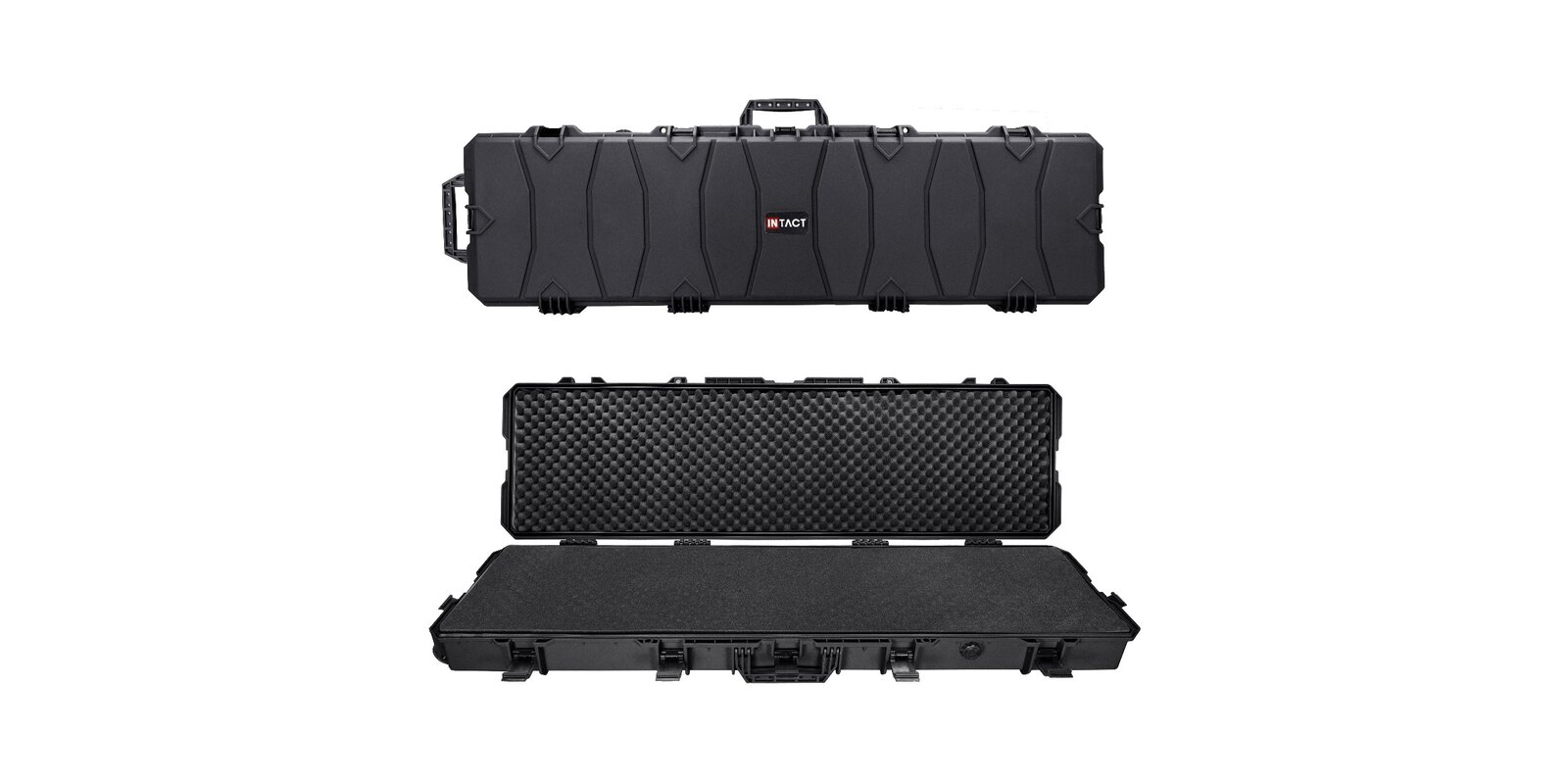
For case selection, match interior length to your longest rifle with the optic mounted. Eylar® hard rifle and handgun cases are molded from reinforced high-pressure polypropylene with standard padlock mounting points, and the Stacker Series cases stack with each other so two or three of them sit as one block instead of sliding around a unit.
| Case | Interior | Exterior | Weight |
|---|---|---|---|
| 54″ Stacker Series hard roller rifle case | 51.57″ x 13.19″ x 4.92″ | 54.25″ x 15.74″ x 5.51″ | 15 lb |
| 48″ Intact Stacker Series rifle case | 46.46″ x 10.83″ x 3.94″ | 48.03″ x 12.99″ x 4.33″ | Not listed |
| 39″ Intact Stacker Series rifle case | 38.78″ x 12.01″ x 3.15″ | 39″ x 13.78″ x 4.28″ | 5.29 lb |
| 39″ Intact Stacker Series rolling rifle case | 37.20″ x 11.61″ x 4.92″ | 39.37″ x 13.77″ x 5.51″ | 10.9 lb |
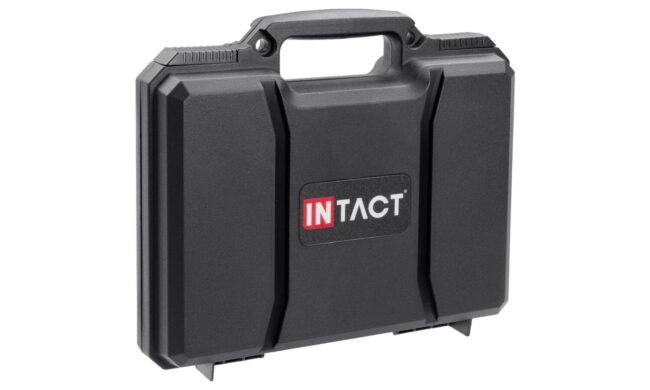
| 11.7″ Intact Stacker Series handgun case | 11.61″ x 8.46″ x 3.15″ | 11.73″ x 10.24″ x 3.46″ | 1 lb |
All five cases take standard padlocks: the 39-inch hard shell rifle case has four padlock mounting points, and the other four have two each.
A full-size AR or bolt gun with a scope usually needs the 54″ Stacker Series hard roller rifle case, which carries four foam layers (one convoluted, two pull-and-pluck, one solid pad) and rolls on integrated wheels, so you are not dragging the case plus rifle across a parking lot by hand. A shorter carbine or broken-down shotgun fits the 48 inch Intact Stacker Series hard shell rifle case. Two 39-inch Stacker options cover shorter and takedown guns: the hard shell version has four padlock mounting points, and the rolling version adds five foam layers and two solid wheels. Pistols go in the 11.7″ Intact Stacker hard handgun case, which weighs about a pound empty and stacks on top of the long guns.
If you want a sealed case for the harshest unit, the Tactical Skull hard roller rifle case with RAGAR foam insert is IP67-rated waterproof and dustproof, and its RAGAR XP crosslinked closed-cell blocks lift out and go back, so one case can hold a different layout later. If you are fitting foam to a case you already own, the RAGAR case foam size chart will tell you what fits.
Can you store ammunition in a storage unit?
Usually not, and this is the one line most facilities draw hard. Ammunition and primers are classified as hazardous or explosive material in a large share of storage leases, and fire codes in many jurisdictions restrict quantities in rented commercial space. Even where it is permitted, a sealed metal unit that reaches high summer temperatures is a poor place for primers and powder, and propellant degrades faster when it cycles hot and cold.
Keep ammunition at home in a cool, dry place, or give it to a trusted person while you are away. If the facility does allow it in writing, keep quantities small, keep it in a separate sealed container from the firearms, and tell the manager it is there so the fire department isn’t surprised.
Insurance, records, and when a storage unit is the wrong answer
Most facility insurance plans exclude firearms. Check your homeowners or renters policy: some cover property in off-premises storage at a reduced limit, and many cap firearm coverage low enough that one rifle blows through it. A scheduled rider or a dedicated firearms policy is the usual fix. Before anything goes in the unit, write down every serial number, photograph each gun from both sides, and keep that record and your receipts at home or in cloud storage. If a gun is stolen, police need the serial number within minutes, not next week.
A storage unit is the wrong tool when:
- Your lease prohibits firearms and the manager won’t put an exception in writing.
- You are storing guns because someone in the household is in crisis. A licensed dealer, a law enforcement agency that accepts holds, or a trusted relative creates real distance and a clear hand-off; a unit you can open in the middle of the night does not.
- The unit is drive-up metal with no climate control and you need storage longer than a season.
- You can’t visit quarterly to check desiccant and wipe metal.
- The firearm is high value or collectible. Those belong with a dealer’s climate-controlled storage service or in a safe at home.
If the unit is the right answer, the short version is simple: a legal lease, a locked hard case with closed-cell foam and desiccant, nothing on the concrete, ammunition elsewhere, serial numbers written down, and a calendar reminder. Compare sizes in Eylar’s rifle cases, or look at biometric safes if the gun is coming home instead.
FAQ
Will a gun rust in a non-climate-controlled storage unit?
It can, within a single humid season. The culprit is condensation from day-to-night temperature swings, not the unit itself. A hard case with closed-cell foam, a corrosion-preventing film of oil on the metal, and fresh desiccant with an indicator card keeps the air around the gun dry enough that rust doesn’t start. Check and recharge the desiccant every few months.
Does a storage facility have the right to open my unit and find the guns?
Yes, under circumstances spelled out in your lease — emergencies, repairs, pest control, or a lien after nonpayment. That is why the lease clause matters more than state law for most people, and why a second locked container inside the unit is worth it. Keep the account current and use auto-pay if you’ll be away.
Can someone else pick up my guns from the unit while I’m deployed?
Be careful here. Giving another person a key or gate code to a unit holding firearms can be treated as granting access or possession, and in some states that touches loan and transfer rules. It is a federal problem if that person is prohibited from possessing firearms. Talk to an attorney in your state before you arrange it, and consider a licensed dealer hold instead.
