
The three bed measurements that decide whether a tool box or cargo case fits, how crossover and chest boxes are measured differently, typical sizes by truck class, and the clearances people forget until the box is already in the driveway.
What size tool box fits my truck comes down to three numbers: the outside bed rail width at the bulkhead, the width between the wheel wells, and the bed depth from floor to rail. Measure those three, then compare them to a box’s exterior dimensions — not its advertised volume or interior size.
Interior capacity tells you what you can pack. Exterior dimensions tell you whether the lid will close, the tailgate will swing, and the box will drop between the wheel wells. Those are different problems, and most fitment mistakes come from reading the wrong number.
Which three measurements decide what size tool box fits my truck?
Take a steel tape, a helper, and five minutes. Write everything down in inches with a fraction, not a rounded guess. Half an inch decides a lot of these.
| Measurement | Where to take it | What it decides |
|---|---|---|
| A. Outside rail width | Across the bed at the bulkhead (front of the bed), outer edge of one rail to outer edge of the other | Maximum width of a crossover/saddle box that sits on top of the rails |
| B. Wheel well gap | At bed-floor level, inside face of one wheel well to the other, at the narrowest point | Maximum width of any chest box or cargo case that sits on the floor between the wells |
| C. Bed depth | Bed floor straight up to the top of the rail (do this with your bed liner or mat in place) | How tall a box can be and still sit below the rail line, under a tonneau or a rack |
| D. Bulkhead-to-wheel-well length | Front wall of the bed back to the front edge of the wheel well arch, at floor level | How long a full-width box can be before it has to clear the arches |
| E. Rail-to-window clearance | Top of the bed rail up to the bottom edge of the rear cab window, measured at the front of the bed | How tall a crossover lid can be without blocking the rear window or third brake light |
A, B and C settle the question. D and E keep you from buying something that technically fits and still ruins your rear visibility or crowds the cab on a short bed.
Why are crossover boxes measured at the rail and cargo cases at the floor?
A crossover (saddle) box spans the bed and rests its mounting flanges on top of both rails. Its width is cut to the outside rail number, and the body hangs down into the bed behind the cab. That means measurement A controls fit, and the box’s depth has to clear your bed floor — not sit on it.
Chest boxes, low-profile cargo cases and drawer units sit on the bed floor instead. They are governed by measurement B, the wheel well gap, which is always the narrower number. A box that fits on the rails can be far too wide to drop onto the floor.
Side-mount and fender-well boxes are a third case: they bolt to the inside of the rail or in the “pork chop” space ahead of or behind the wheel arch. They eat into measurement B, so if you run one, measure the remaining floor width after it is installed.
The practical rule: if the box touches the rails, use A. If it touches the floor, use B. Never shop with the number from the wrong list.
What box size fits a compact, half-ton or heavy-duty bed?
Trim levels, bed liners, spray-in coatings and bed-rail caps all move the numbers, so there is no universal chart — confirm everything with your own tape. What does hold true is which measurement limits you, and that is different per class.
| Truck class | Which measurement usually limits you | Box sizing that usually works |
|---|---|---|
| Compact / mid-size | B — the wheel well gap is tight, and the bed is the shallowest of the three classes | Mid-size crossover boxes; one floor case placed crosswise against the bulkhead |
| Half-ton full-size | C — most boxes fit between the wells, but tonneau and rack clearance gets tight | Full-size crossover boxes; a long, low floor case crosswise on the widest beds |
| Heavy-duty (3/4- and 1-ton) | Rarely width; usually lid height versus the rear window (E) | Full-size crossover; deeper chest boxes; room for stacked floor cases |
| Dually / flatbed | Deck length and mounting points — often no wheel wells at all | Measure the deck; underbody and chest boxes dominate |
A common gotcha: people assume a one-ton takes a wider box than a half-ton. Rail widths across modern full-size trucks are often within a couple of inches of each other, and the same full-size crossover box spans both. The real difference is bed depth and payload, not width.
Does bed length — short, standard or long — change what fits?
Width decides whether the box fits. Length decides how much of your bed it eats and what else you can still haul.
- Short bed: A standard crossover box can swallow a third of your usable floor. The cab also rakes forward on many short beds, so check measurement E carefully — a tall, boxy lid can crowd the rear window. Low-profile is your friend here.
- Standard bed: The most forgiving. Most full-size crossover boxes still leave room for a full sheet of plywood laid flat on the wells behind the box, plus floor cases down the sides.
- Long bed: You can run a crossover box at the bulkhead and floor cases or a chest box behind it without losing the ability to carry long material.
On any bed, measure D (bulkhead to wheel well) before buying a floor box you plan to slide all the way forward. Many beds have a narrowing taper or a tie-down bracket right where the box wants to sit.
Which clearances do buyers forget until the box is in the driveway?
Width and depth are the easy part. These are the measurements that come back to bite:
- Bed liner thickness. A drop-in liner steals half an inch to a full inch off both the wheel well gap and the bed depth. Measure with the liner in, not after you pull it out for the photo.
- Tailgate swing. A floor box pushed to the rear needs the tailgate to drop past it. Check the gap with the gate down, not up.
- Third brake light and rear window sightline. Sit in the driver’s seat and have someone hold a tape at box height behind the cab. If it blocks the center mirror view, you will hate it in a week.
- Tonneau or bed cover. Roll-up and folding covers want everything below the rail line. Compare the box height to measurement C minus about an inch for the cover’s rail hardware.
- Cab rake on short beds. A tall lid that clears at the rail may not clear at the top of its swing.
- Lid curvature and foam. Interior dimensions are usually taken at the widest point. Curved lids, radiused corners and a foam layer all shrink real usable space. If you are adding foam, measure the cavity properly — this guide to measuring a case for replacement foam shows where to take the numbers.
- Latch and handle projection. Latches, hinges and handles can add an inch or more beyond the listed body dimensions. If you are fitting two cases side by side, leave a finger’s width of slop.
Pre-purchase checklist — do all seven before you order:
- Measure A, B and C with the bed liner installed.
- Measure D and E and write them on the same note.
- Subtract an inch from B for knuckle room and any side-mount hardware.
- Decide: rail-mounted or floor-sitting? Use the matching number.
- Check the box’s exterior dimensions against yours, not its liters or interior size.
- Simulate it — tape a cardboard box together or mark the bed floor with painter’s tape, then drop the tailgate.
- Confirm the tonneau, rack or camper shell still closes over the planned height.
When does a low-profile cargo case beat a full-width crossover box?
A crossover box is the right answer if you want one fixed, lockable volume behind the cab and you never need the bed floor under it. Modular cases win when gear has to leave the truck — into a shop, a campsite, or the garage — and when the layout changes from job to job.
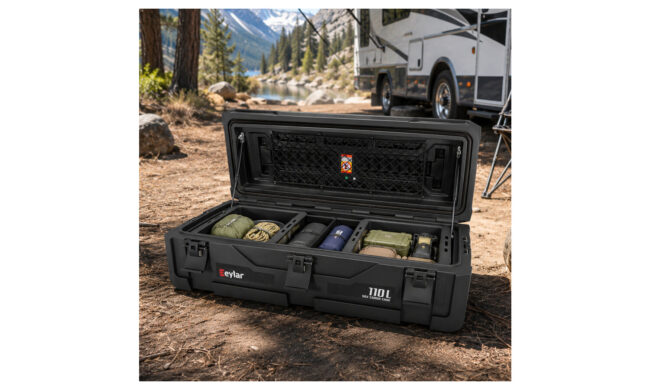
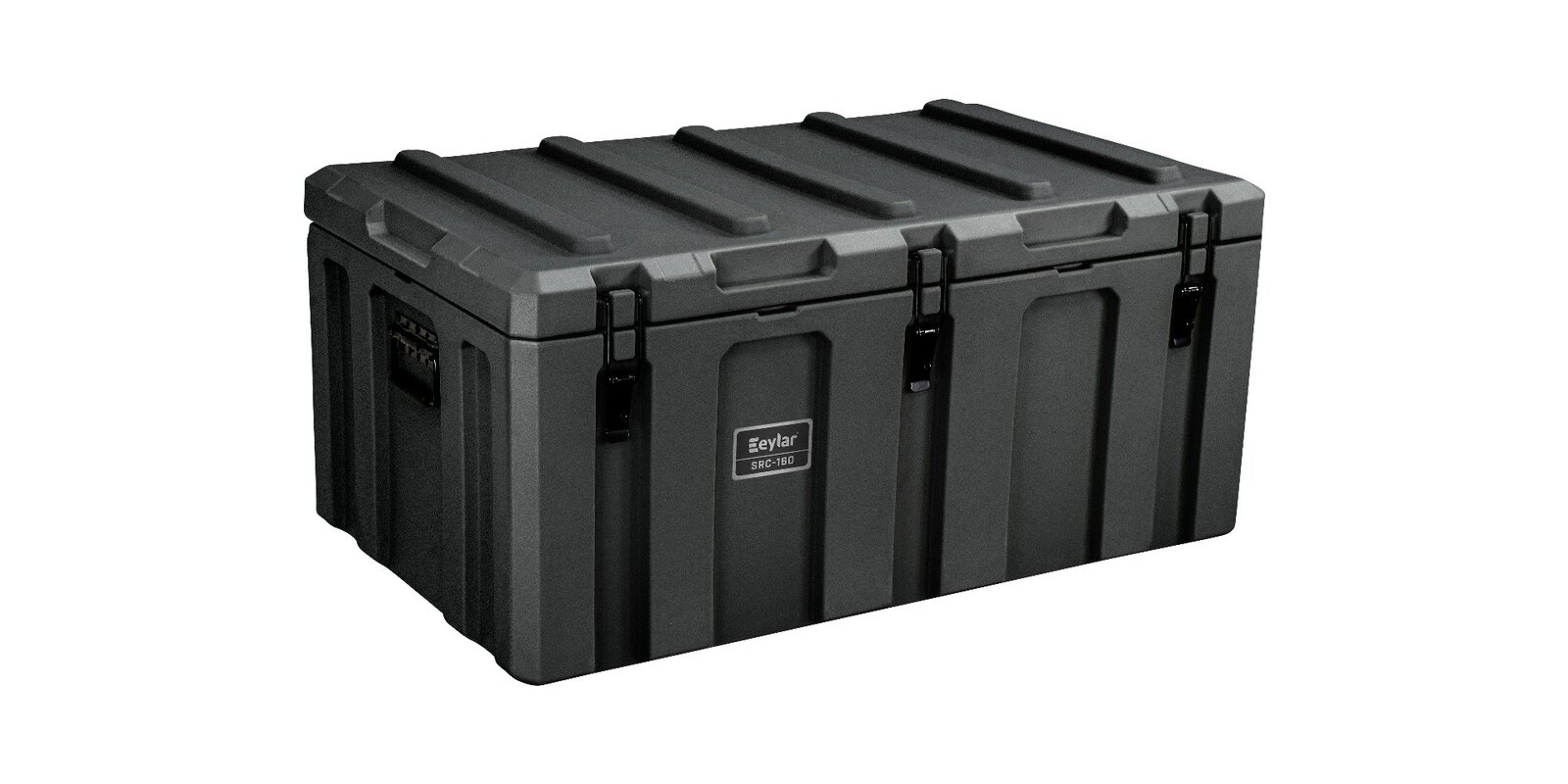
Eylar®’s roto-molded cargo cases sit on the bed floor, so measurement B governs them. They are one-piece LLDPE with a weatherproof gasket, integrated lockable points, and a seamless shell with no welds or seams to split. They also stack and mount to a roof rack, which matters when you would rather build up than spread out. Here are the exterior numbers that decide bed fitment:
| Case | Exterior (L x W x H) | Interior | Weight | Where it tends to fit |
|---|---|---|---|---|
| SRX-50 (50L) | 23.4″ x 18.3″ x 13.3″ | 18.7″ x 13″ x 8.91″ | 20 lb | Single case fits almost any bed floor; for two side by side, add the two exterior widths and compare to B |
| SR-50 (50L) | 25.6″ x 15.2″ x 13.75″ | 21.9″ x 11.25″ x 11.34″ | 18 lb | Narrow footprint — good along a bed side rail or stacked |
| SRX-90 (90L) | 32.7″ x 18.4″ x 14.6″ | 27.9″ x 13″ x 10″ | 27.2 lb | Goes crosswise against the bulkhead on most mid-size and full-size beds |
| SRC-160 (38″) | 37.8″ x 22.8″ x 17.8″ | 36″ x 20.9″ x 14″ | 35 lb | Biggest single volume here; the tallest too, so check bed depth (C) before adding a tonneau |
| SRX-110 (110L) | 47.2″ x 18.4″ x 13.2″ | 42.5″ x 12.7″ x 8.5″ | 37.5 lb | Low and long — crosswise between the wells on the widest full-size beds |
Note the heights: every case above is in the low-profile range. On most full-size beds they sit below the rail line, which is what makes a tonneau or rack work. If clearance is the tight constraint, the SRX-110 at 13.2 inches tall is the flattest of the group. If you want a box that clears the wheel wells on a mid-size bed, the SRX-90 at 32.7 inches long is the easier fit crosswise. All of these are rated IP4 water resistant, not submersible, so they handle rain, dust and river crossings rather than full immersion.
These roto-molded cargo cases do not include a foam insert. If you add one to stop tools rattling, budget an inch or two of interior height for base and lid layers before comparing interiors; RAGAR reusable foam blocks lift out and go back, so the layout can change with the load. For exterior and interior dimensions on every model, compare the overland cargo case range, or the tool box collection if you want a dedicated jobsite setup. Eylar ships free in the US and accepts returns for 30 days, which takes some of the risk out of a borderline measurement.
FAQ
Should I measure my truck bed with the liner in or out?
In. A drop-in liner typically takes half an inch to an inch off both the wheel well gap and the bed depth, and that is exactly the margin that decides whether a box drops in or binds. If you plan to add a spray-in or drop-in later, measure now and subtract an inch as a safety margin.
If a crossover box fit my half-ton, will it fit a heavy-duty truck?
Usually yes on width — rail widths across modern full-size trucks are often within a couple of inches, and the same “full-size” crossover box spans both. What changes is bed depth and bed length. Take measurement A at the bulkhead on the truck you actually own, because bed-rail caps and trim differences move it.
How much interior space do I lose to foam and lid shape?
Expect to lose an inch or two of usable height to a foam base and lid layer, plus a little at the corners from the mold radius. Listed interior dimensions are measured at the widest point, so a long, rigid item that matches the interior length on paper may still not lie flat. Measure your longest tool first, then shop.
