

A clear, step-by-step method for tracing, plucking and test-fitting pull-and-pluck foam so your compound bow, arrows and accessories sit tight and stay put in a hard case.
How to customize pluck foam for a bow case: lay the bow on the foam, trace the outline with a marker, then pull cubes from inside the line one small column at a time. Leave 1–2 inches of foam around the bow, test-fit often, and pluck the last cubes only where the bow still binds.
The rest of this page covers the details that decide whether the pocket holds your bow for years or turns into a loose, torn cutout after one season: wall thickness, depth, arrow storage, and what to do if you pull too much.
How do you customize pluck foam for a bow case, step by step?
Work on a flat table, in good light, with the case open and level. Rushing the trace is what causes most bad cutouts.
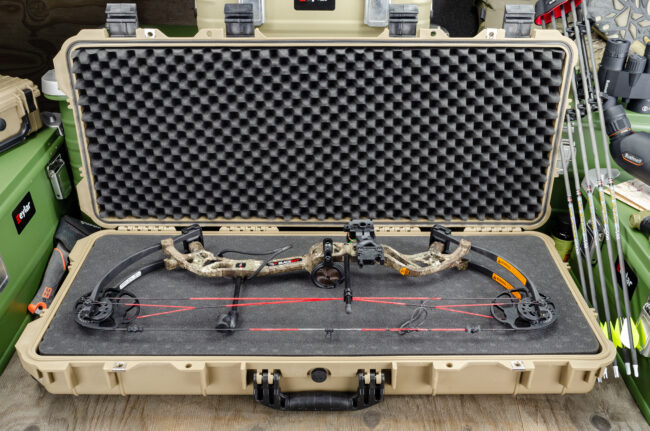
- Dry-fit first. Set the bow on top of the pluck layer exactly how you want it to travel — usually riser down, cams clear of the hinge side, sight and quiver either removed or placed in their own pockets.
- Trace the outline. Use a fine permanent marker and keep the tip tight against the bow. Trace the riser, limbs, cams and anything else that will sit in that layer.
- Check the line. Lift the bow out and look at the outline from directly above. Redraw any faint or broken sections now, not after you start plucking.
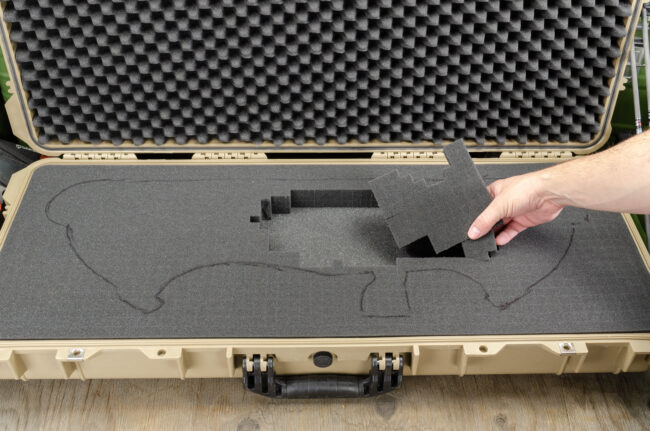
- Pluck inside the line, not on it. Start in the middle of the shape and pull cubes straight up, one small column at a time. Leaving the cubes that the marker line runs through gives you a tighter grip on the bow.
- Go down one layer at a time. Pull the top portion of a column, test the depth, then take more if needed. Foam you remove does not go back in.
- Test-fit constantly. Drop the bow in every 10–15 cubes. Where it binds, pluck one more cube. Where it rattles, stop.
- Close the lid and listen. With the lid latched, tilt the case side to side. No movement, no clicking. If the bow shifts, you took too much or you need more top pressure from the convoluted lid foam.
- Repeat for accessories. Same process for a release, rangefinder, broadhead box, wax and spare strings — each gets its own pocket so nothing slides into the cams.
Quick pluck checklist
| Step | Do this | Watch out for |
|---|---|---|
| Layout | Position the bow before you touch the marker | Cams or sight sitting over the case hinge |
| Trace | Fine-tip permanent marker, tight to the bow | Wide gaps that turn into a sloppy fit |
| Pluck | Small columns, inside the line | Grabbing handfuls and tearing neighboring cubes |
| Depth | Remove in stages, test after each stage | Plucking through to the solid base pad |
| Walls | Keep 1–2 inches between the bow and the case wall | Thin walls that collapse under a stack of luggage |
| Final | Latch the lid, tilt, listen for movement | Loose accessories rolling into the bow |
What do you need before you start?
Very little, and none of it is special.
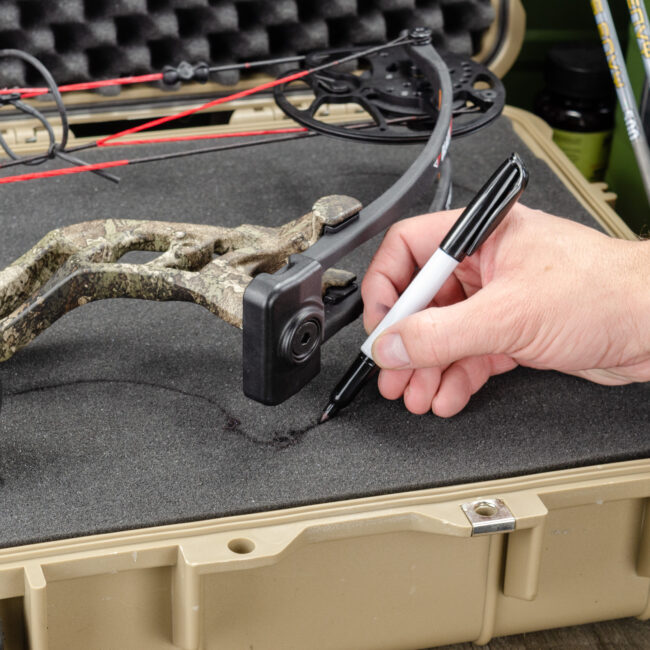
- Fine-tip permanent marker (a light-colored paint pen shows up better on black foam)
- Flat table and a clear 5–6 feet of space
- The bow set up the way it will travel — same quiver, same sight, same stabilizer
- A bag or box for plucked cubes (keep them; they are useful later)
- A sharp utility knife only if you need to slim a wall or shave a corner, not for the main shape
Skip the knife for the general outline. Plucked cube walls grip better than knife-cut walls because the slightly ragged faces press back against the bow.
How much foam should you leave around the bow?
Aim for at least 1–2 inches of foam between the outside of your cutout and the inside wall of the case, and keep a solid base layer under everything. That buffer is what absorbs a drop or a baggage-handler toss. A cutout that reaches the case wall leaves nothing between your riser and the shell.
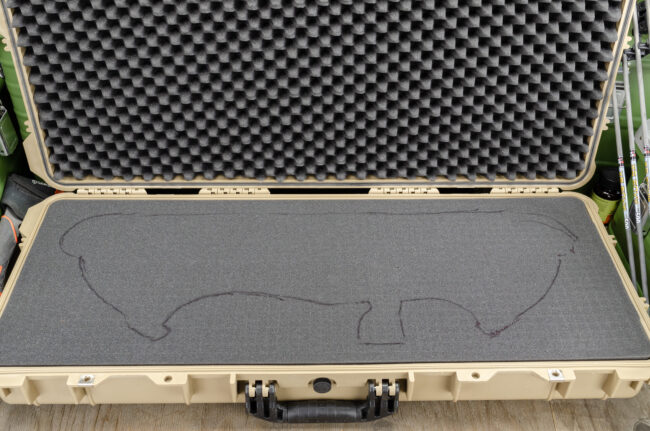
Depth matters just as much. The bow should sit slightly below the top of the pluck layer so the convoluted lid foam presses down on it when the case closes. If the bow stands proud of the foam, the lid does the clamping and the pressure lands on your cams instead of the foam.
Two more habits that pay off:
- Leave a lift notch. Pluck one or two extra cubes at the riser so you can get fingers under the bow without pulling on the sight.
- Keep cutouts separated. Two pockets with a single cube between them will tear. Leave two or three cubes of foam between neighboring shapes.
Do Eylar® bow cases already come with bow-shaped foam?
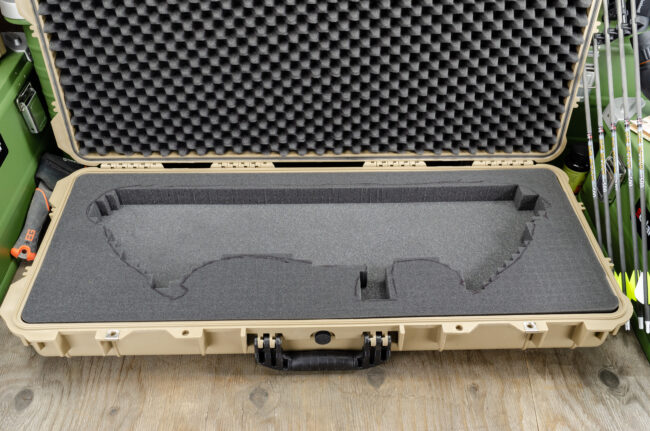
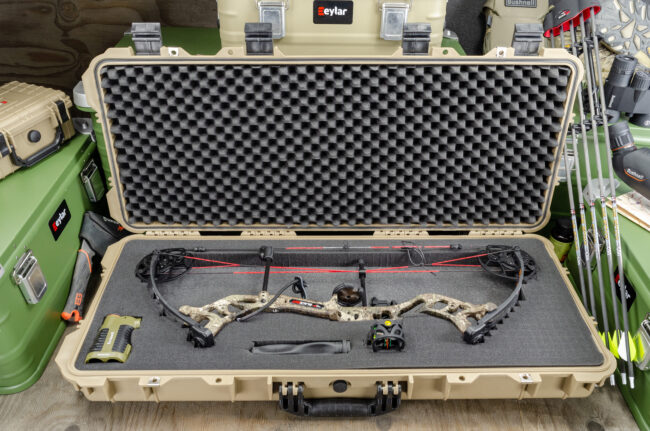
Yes — and it is worth knowing before you start cutting anything. The 48″ Stacker Series Deep Wide Roller Bow Case with Pre-Cut Foam ships with three layers: one convoluted layer, one pre-cut bow foam layer with three removable inserts, and a convoluted bottom pad. Its lid has an integrated arrow foam organizer section that holds up to 12 arrows. The case measures 48.03″ x 20.08″ x 7.28″ outside and 45.28″ x 17.72″ x 6.30″ inside, weighs 17.86 lb, carries an IP67 rating, and uses a reinforced high-pressure polypropylene body with two standard padlock mounting points and a center handle. It comes in black or tan.
If your setup is longer and narrower, the 54″ Stacker Series Hard Roller Bow Case uses the same three-layer pre-cut arrangement with three removable inserts and the 12-arrow lid organizer, in a 54.25″ x 15.74″ x 5.51″ shell with a 51.57″ x 13.19″ x 4.92″ interior, 15 lb, IP67, tan. Both are Stacker cases, so they stack with other INTACT Stacker Series cases for transport.
With a pre-cut layer, pull the removable inserts first and dry-fit. Often the bow drops right in and you only need to customize around the edges for a sight or quiver. Compare the full lineup on the Eylar bow case page and measure your bow tip-to-tip and at its widest cam sweep before you choose a size.
Pull-and-pluck layers show up elsewhere in the Stacker line too. The 54″ Stacker Series Hard Roller Rifle Case carries four layers of foam — one convoluted, two pull-and-pluck and one solid pad — which is a good base for a full custom pluck job. Its 51.57″ x 13.19″ x 4.92″ interior is shaped for long guns, so check your bow’s axle-to-axle width against that number before you assume it fits.
How do you make room for arrows and accessories?
Arrows should never share a pocket with the bow. On the Eylar bow cases the lid already has an arrow organizer section sized for up to 12 arrows, so fletching stays clear of the riser and cams.
For everything else, pluck a small grid of pockets along one end of the case:
- Release aid — shallow pocket, snug, near the handle end so it is easy to grab
- Broadhead case — tight rectangular pocket with full-depth walls
- Rangefinder and wax — two separate small pockets, not one shared tray
- Spare string and cables — one wider, shallow pocket; do not let them coil against the cams
- Allen wrenches and tags — one narrow slot each
Label nothing on the foam itself until you have hunted with the layout once. Pocket positions almost always move after the first trip.
What if you pluck too much foam?
It happens, and it is fixable. Three options, from quickest to most permanent:
- Put cubes back. Press saved cubes back into the gap. They hold better than people expect, especially under lid pressure.
- Glue a shim. A thin strip of foam glued to the pocket wall tightens a fit without redoing the layer.
- Replace the layer. If the pocket is badly torn or the walls are thin, swap in a fresh pluck layer instead of trusting a weak pocket with your riser. Measure the case interior length, width and foam thickness first — this guide to measuring a case for replacement foam walks through the method.
If you change bows, sights or quivers often, remember that every pluck cut is permanent, so each change means another layer. That is the argument for a reconfigurable system: RAGAR is Eylar’s reusable foam made from XP crosslinked closed-cell foam, where blocks lift out and go back in so the layout can change without cutting. It is covered by U.S. Patent No. 12,358,707, and you can browse the RAGAR customizable foam options if you want a layout you can undo.
FAQ
Can you put plucked foam cubes back in?
Yes, for small corrections. Press the cubes back into the hole and let the lid foam hold them down. They will not be as strong as untouched foam, so keep replaced cubes away from load-bearing walls — and save your cubes in a bag instead of tossing them.
Should I trace around the sight and quiver or remove them first?
Decide once and stay with it. If you travel with the sight and quiver mounted, trace them in place so the pocket matches the real shape. If you pull them off every trip, pluck separate pockets for them — you get a stronger, simpler main cutout and a case that handles setup changes better.
Does a plucked pocket hold up to airline baggage handling?
It does if you leave enough wall thickness and depth. Keep 1–2 inches of foam between the bow and the case wall, keep the solid base layer intact under the cutout, and make sure the lid foam presses down on the bow. The Eylar bow cases also have two standard padlock mounting points, so lock both before the case goes to the counter.
Worn out the pluck foam? Our gun case foam buying guide explains which type and thickness to order as a replacement.
