
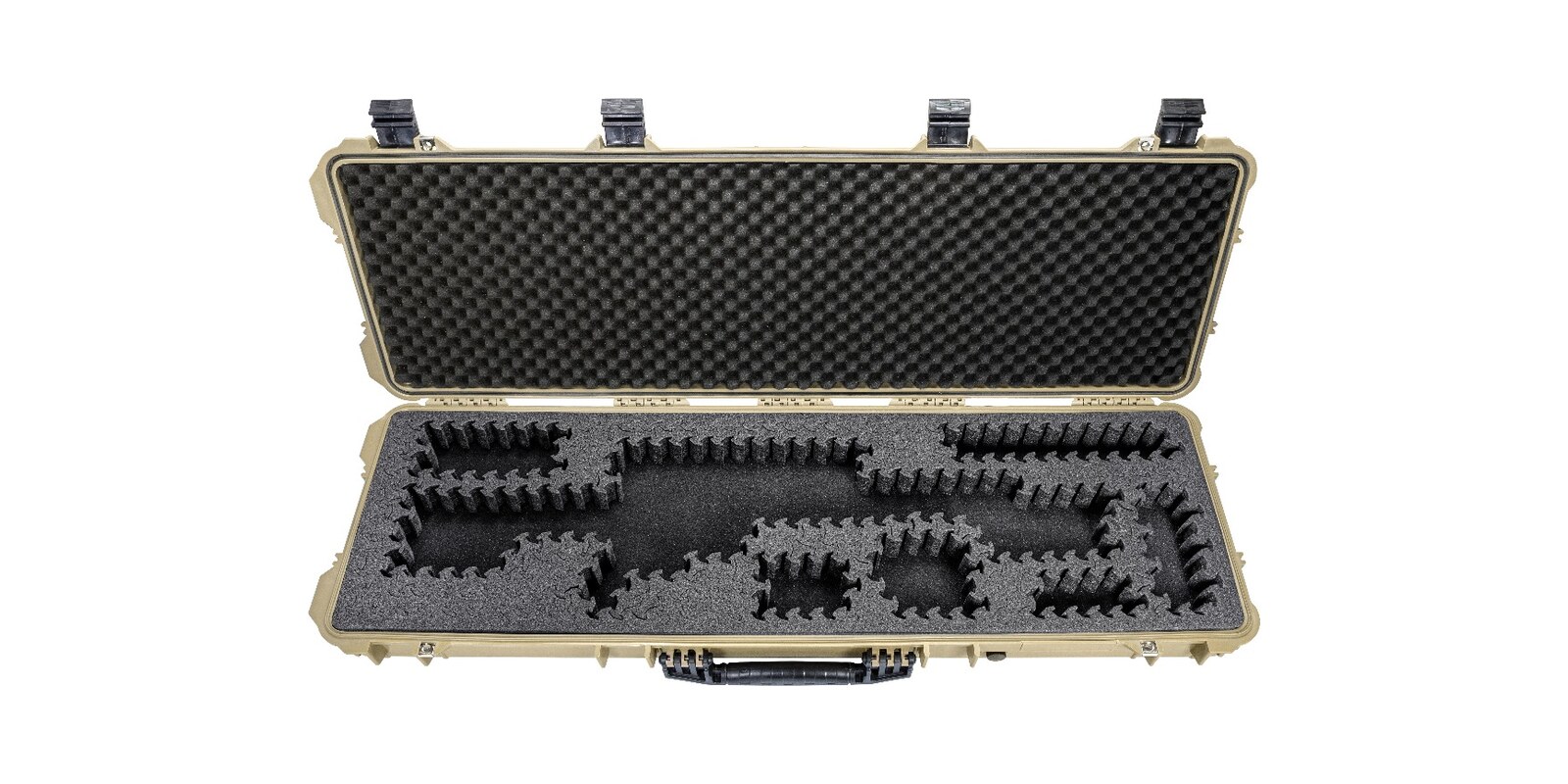
A step-by-step pre-flight checklist for flying with a firearm: what "TSA-approved" means for a hard case, how many padlocks you need, how to pack ammo, and how to keep your optic zeroed through baggage handling.
A TSA-approved gun case is simply a hard-sided, fully enclosed container that locks — TSA certifies no brands. To fly, the firearm must be unloaded, locked in that case, declared in person at the airline counter, and checked as baggage. Ammunition travels in a box made for ammunition. Keep the keys with you.
What makes a gun case TSA-approved?
There is no approval list and no sticker. Screeners and airline agents judge the case against four physical conditions. If your case meets them, it flies.
| Requirement | What it means in practice | What fails |
|---|---|---|
| Hard-sided | A rigid shell — polypropylene or similar — that keeps its shape under a loaded baggage cart | Soft cases, gun socks, padded sleeves, backpacks, zippered bags of any kind |
| Fully enclosed | No gap at the lid seam or hinge; nothing can be reached without opening the locks | Cases that flex open at the ends, broken hinges, missing gasket or lid |
| Locked | Padlocks through the hasps or mounting points, closed and tested | Latched-but-unlocked cases, combination dials left open, one lock on a long lid |
| Only you can open it | You carry the key or combination and can open the case if screening asks | Keys packed in the checked bag or inside the locked case |
Two more rules sit alongside the case itself. The firearm must be unloaded, and it must be declared verbally at the airline check-in counter — never at a kiosk, never curbside, never in a carry-on. You sign a declaration card, the bag gets tagged, and it usually goes to an oversized-baggage screening point where you may be asked to wait a few minutes in case a screener needs you to open it.
Eylar®, based in Pomona, California, builds its hard cases on a reinforced high-pressure polypropylene body with padlock-adaptable hasps, which is exactly the construction the rule is written around. The full range of hard gun cases is sorted by length, so you can size first and add locks separately.
Quick pre-flight check:
- Firearm unloaded, chamber empty, magazine out.
- Case hard-sided, closed, and locked at every mounting point.
- Ammunition boxed, in checked baggage, within the airline’s weight limit.
- Keys and photo ID on your person.
- Declaration made face to face at the full-service counter.
What kind of gun case do I need to fly with a handgun?
A pistol follows the same rule as a rifle, just in a smaller box: hard shell, fully enclosed, locked. The usual setup is a compact locked handgun case packed inside an ordinary checked suitcase. The suitcase itself does not need to be locked — the gun case does. Pack the gun case near the top so it can be reached if the suitcase is opened for inspection.
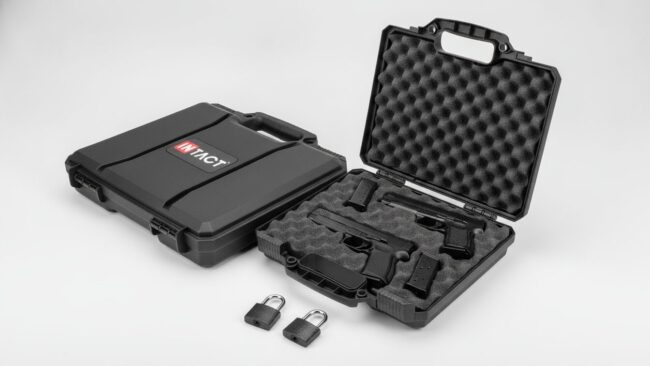
Size the case around the pistol plus what travels with it: spare magazines (empty), a holster, a mounted red dot. Compare your measurement against the interior dimension, not the exterior, and leave about half an inch on each side for foam.
| Handgun setup | Eylar case | Interior (L x W x D) | Notes |
|---|---|---|---|
| One full-size or compact pistol plus magazines | 11.7″ Intact Stacker hard handgun case | 11.61″ x 8.46″ x 3.15″ | About 1 lb, two padlock mounting points, convoluted foam top and bottom, fits inside most suitcases |
| Pistol with optic and light, plus tools and gear | 10.62″ Small Deep Gear & Camera hard case with foam | 9.17″ x 7″ x 6.12″ | 3.17 lb, IP67 sealed, pressure-equalization valve, two padlock-adaptable hasps, three foam layers |
Depth is the number people miss. A pistol with a tall red dot and a weapon light stacks up past 3 inches once foam is under and over it, so a deeper case solves more problems than a longer one.
What size TSA-approved rifle or shotgun case do I need?
A long gun case travels as its own checked bag, so it has to clear two extra bars: survive an oversized-baggage conveyor, and be long enough that the gun sits fully below the lid seam with foam on every side.
Measure the firearm with the optic, bipod and magazine you plan to fly with. Add roughly an inch at each end, then match that to interior length. Shotguns are measured the same way — overall length including the buttpad — and a break-action or takedown shotgun fits a much shorter case than a long-barreled pump gun.
| What you’re flying with | Eylar case | Interior (L x W x D) | Notes |
|---|---|---|---|
| Carbine or takedown rifle, lightest option | 39″ Intact Stacker hard shell rifle case | 38.78″ x 12.01″ x 3.15″ | 5.29 lb, four padlock mounting points, convoluted foam top and bottom |
| Carbine with optic, wheels wanted | 39″ Intact Stacker rolling hard rifle case | 37.20″ x 11.61″ x 4.92″ | 10.9 lb, five foam layers, two padlock points, two solid wheels |
| Standard rifle or shotgun up to 46″, slim profile | 48″ Intact Stacker hard shell rifle case | 46.46″ x 10.83″ x 3.94″ | Two padlock points, stacks with other Stacker cases |
| Scoped rifle with bipod, or a full-size shotgun | 48″ Hard Roller Rifle Case with RAGAR 46″ insert | 46.1″ x 13.4″ x 5.5″ | 22.1 lb, IP67 waterproof, rubber gasket seal, three foam layers |
| Long-action rifle, long-barrel shotgun, or two guns | 54″ Stacker Series hard roller rifle case | 51.57″ x 13.19″ x 4.92″ | 15 lb, four foam layers, two padlock points, integrated solid wheels |
Depth decides more than length for scoped guns. A 50mm objective in tall rings needs close to 5 inches of interior height before the lid foam stops pressing on the turrets. Wheels matter on the longest cases — the walk from the counter to oversized screening is longer than it looks. The rest of the lineup is on the rifle cases page, including UV-printed roller cases with RAGAR foam if you’d rather not own a black box that looks like everyone else’s.
How many locks does a gun case need when flying?
The rule says “locked.” It does not give a number. In practice one padlock in the middle of a 48-inch lid lets the far ends gap when the case is pulled, and an agent can refuse it on that basis. The reliable answer: fill every padlock hole the case has.
| Eylar case | Padlock mounting points | Locks to bring |
|---|---|---|
| 11.7″ Intact Stacker handgun case | 2 | 2 |
| 10.62″ Small Deep Gear case | 2 padlock-adaptable hasps | 2 |
| 39″ Intact Stacker hard shell rifle case | 4 | 4 |
| 39″ Intact Stacker rolling rifle case | 2 | 2 |
| 48″ Intact Stacker hard shell rifle case | 2 | 2 |
| 54″ Stacker Series roller rifle case | 2 | 2 |
Four mounting points on a long case is the stiffest arrangement, because no single corner can be levered. TSA permits any brand or type of lock on a firearm case. Most experienced travelers use plain keyed or combination padlocks: the whole point of a firearm case is that nobody else opens it, and a screener who needs to look inside will page you rather than use a master key.
Buy padlocks in matched sets so you aren’t juggling four keys in the check-in line, and check shackle diameter against the hole before you order — body size is irrelevant if the shackle won’t pass through. Options are in the locks category.
Airport handgun identification: what ID and paperwork do you need?
Flying with a firearm adds three identification steps that nobody mentions until you’re standing at the counter.
- Your photo ID at check-in. A government photo ID matching the ticket, same as any passenger. A carry permit is not a substitute and is not required to check a firearm, though some states expect you to be legal to possess at both ends of the trip.
- The declaration card. The agent gives you a firearm declaration form to sign. Depending on the airline it goes inside the case — you unlock it briefly in view of the agent — or is attached outside. Either way the card carries your name, so the case and the passenger are tied together.
- ID at pickup. Many airports do not send firearm cases to the carousel. They go to the baggage service office, and you collect them by showing photo ID and the claim tag. Ask at check-in where yours will land, especially on a tight connection.
Identify the case, not the contents. A laser-engraved ID plate with your name and phone number survives baggage handling better than a paper tag and does not advertise what’s inside. Eylar offers custom laser-engraved ID plates for that reason. Strip old airline tags and skip any sticker that says “firearm.”
Before you leave home, photograph the packed case open and closed and write down make, model and serial number for every gun inside. That record is what a damage or loss claim runs on.
Ammunition, foam and keeping your zero through baggage handling
Ammunition causes more arguments at the counter than the case does. The rules that hold across US carriers:
- Ammunition travels in checked baggage only — never a carry-on, never a pocket.
- It must be in a container designed for ammunition: factory cardboard, a plastic ammo box, or fitted slots. Loose rounds rolling in foam get rejected.
- TSA allows small arms ammunition in the same locked hard-sided case as the unloaded firearm. Some airlines insist on a separate container. Check the carrier’s firearm page the week you fly.
- Airlines commonly cap ammunition at around 11 lbs per passenger, but the limit belongs to the carrier. Confirm yours.
- Magazines must be boxed or have the rounds fully covered. Flying with them empty is simpler.
- Firearm parts — frames, receivers, bolts, firing pins — are checked-baggage items. A rifle scope on its own may be carried on.
Cargo holds are cold, pressure changes, and bags land hard. Three things keep a scoped gun shooting where it did last week.
Foam that supports, not just surrounds. Eylar gun cases ship with multiple foam layers — convoluted (egg-crate) foam that presses down from the lid, pick-and-pluck layers you cut to shape, and a solid base pad. The 54″ Stacker roller ships with four layers (one convoluted, two pull-and-pluck, one solid pad); the 39″ rolling case ships with five. Aim for a cavity where the gun sits below the parting line and the lid foam makes light contact: no rattle, no crush.
Clearance around the optic. Carry the rifle at the forend and buttstock and leave air around the objective bell and turret caps. Sustained pressure on a turret is how a zero walks.
Foam you can change later. Pick-and-pluck is one-way — once a cube is out, it’s out. RAGAR is Eylar’s reusable, reconfigurable system made of XP crosslinked closed-cell foam (U.S. Patent No. 12,358,707); the blocks lift out and go back, so the same case can hold a bolt gun this season and a carbine next.
One cargo-hold detail worth checking on a spec sheet: a pressure-equalization valve. A sealed case latched at sea level can fight you after a flight, and the gasket takes the strain. Cases that list one, like the 10.62″ Small Deep Gear case and the IP67 roller rifle cases, equalize on their own without letting water in.
What gets a gun case rejected, and the day-before checklist
Common reasons a case gets turned away at check-in:
- A soft case, gun sock, backpack or padded sleeve — even with a zipper lock.
- A hard case with no padlock points, or one lock on a long lid that gaps when pulled.
- Snap latches with no separate padlock. Latched is not locked.
- A loaded magazine or a loose round anywhere in the case.
- Ammunition in a baggie, pocket or pouch instead of an ammo box.
- A passenger who can’t open the case because the key is in the checked bag.
- Any attempt to check the firearm at a kiosk or curbside.
Run this the night before, in daylight, not at 4 a.m.:
- Read your airline’s firearm page; note the ammo weight limit and whether ammo may share the case.
- Confirm the law at your destination and at any stop where you collect and re-check the bag.
- Verify the firearm is unloaded — chamber empty, magazine out, action open.
- Sweep every foam cavity and pocket for stray rounds.
- Cut or reset foam, close the lid, shake the case and listen. Fix any rattle now.
- Fit a padlock in every mounting point and test each one.
- Keys on your person, spare in your carry-on, never inside the case.
- Remove old tags; add an ID plate with your name and phone.
- Photograph the packed case and record serial numbers.
- Arrive early — the counter, the paperwork and the walk to oversized screening all take time.
If you fly with more than one gun, matching case sizes that stack together make the baggage cart easier to handle; the Intact Stacker Series is built around that. Size by interior length first and depth second. Eylar ships free within the US and takes returns for 30 days.
FAQ
Are Eylar cases TSA approved?
TSA does not approve or certify any brand of case. What it requires is a locked, hard-sided, fully enclosed container, and Eylar hard gun, pistol and rifle cases are built to that standard with a rigid polypropylene shell and padlock-adaptable hasps. Add padlocks in every mounting point and the case meets the rule.
Can ammunition go in the same case as the gun?
TSA allows small arms ammunition in the same locked hard-sided case as the unloaded firearm, as long as it’s in a box or fitted slots designed for ammunition. Some airlines require a separate container and set their own weight limit, so check the carrier’s firearm page before you pack.
Will my rifle lose its zero in checked baggage?
It can, if the optic takes an impact or the rifle shifts. Shape the foam so the rifle is supported at the forend and stock with clearance around the objective and turrets, make sure the lid foam presses down lightly so nothing rattles, and confirm zero at the range before you hunt. Reusable RAGAR foam makes it easy to reshape the cavity when the rifle or optic changes.
