
Pick a camera hard case by how you actually move gear — carry-on, checked baggage, truck beds, drone combo kits or studio-to-location runs — with a sizing table, foam layout rules and the mistakes that crack lens mounts.
The right camera hard case is the smallest sealed, crushproof case that still leaves a finger-width of foam between every piece of glass and the shell. Choose it by workflow first: carry-on flights need compact dimensions, checked bags need locks and a pressure valve, field work needs IP67 sealing, and drone kits need reconfigurable foam.
What size camera hard case matches your kit?
Measure your gear before you shop, not after. Stand your largest body up with the lens you leave mounted, measure the height, then add room for the lid foam that will press down on it. That height — not the footprint — is what kills most case purchases.
Here is how typical kits map to case classes. Interior dimensions are what matter; exterior numbers are for airline sizers and shelf space.
| Your kit | Case class | Interior dimensions | Notes |
|---|---|---|---|
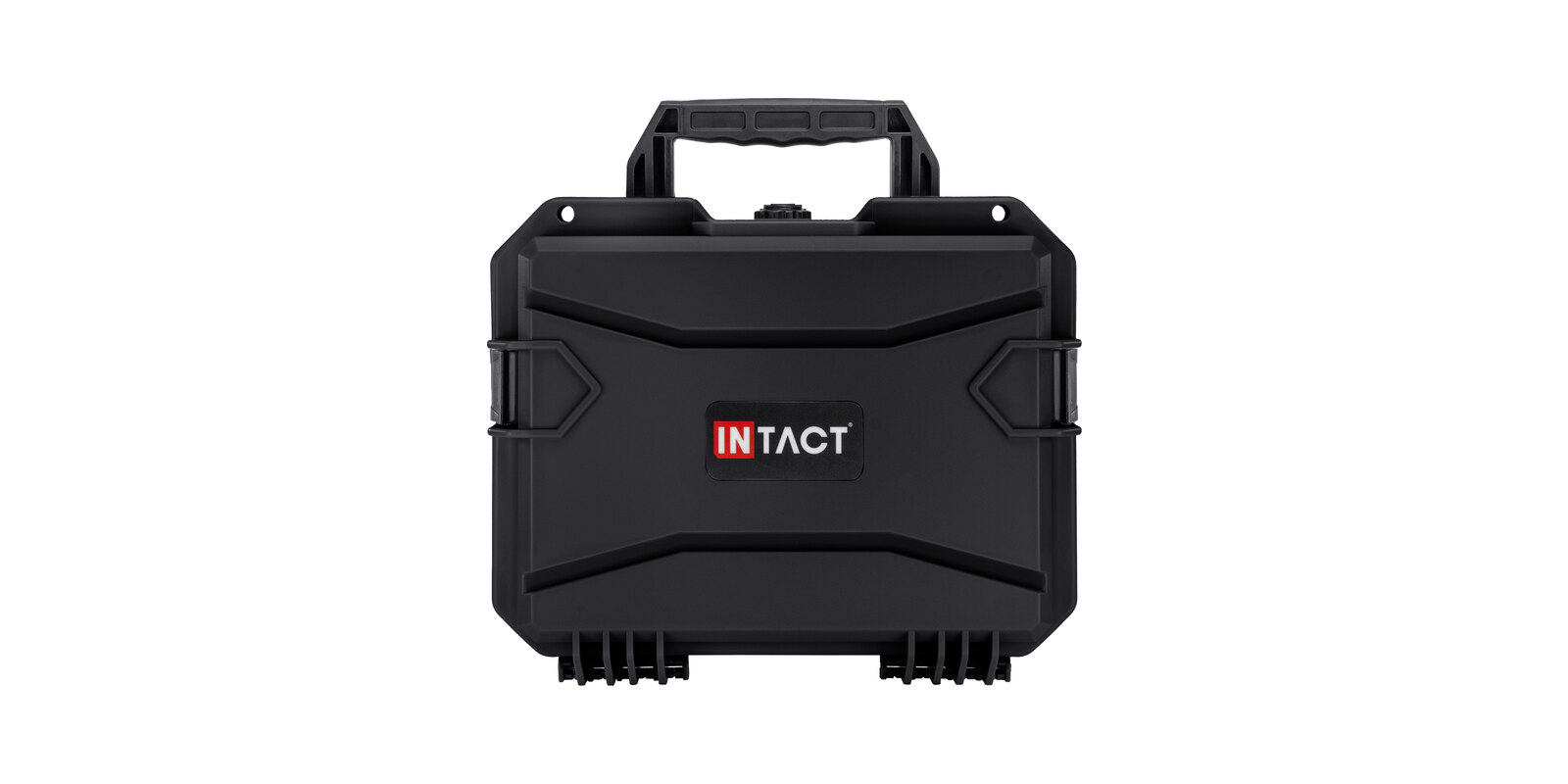
| One mirrorless body, 2 small primes, batteries, cards | Compact — the Eylar® 11.8″ Intact Series compact hard case | 10.24″ x 7.48″ x 4.53″ interior, 2.75 lb empty | Body goes in lens-down with the lens removed, or with a pancake mounted |
| Body with mid-zoom mounted, 2–3 lenses, flash, chargers | Standard — the Eylar 13.8″ Intact Series hard case | 12.20″ x 9.45″ x 5.71″ interior | That interior depth leaves room for a gripped body on its side under lid foam |
| Two bodies, long telephoto zoom, lighting, audio | A large case, or a stacked pair of standard cases | More length and depth than one compact case offers | Two medium cases are easier to lift and load than one oversized box |
| Folding drone, controller, spare batteries, ND filters | Drone or combo case with reconfigurable foam | Room for the folded aircraft plus a shallow accessory tier | Props and batteries need their own compartments |
| Full production kit moved by vehicle | Multiple cases, not one | Mixed sizes from the same family | Matching footprints strap down and stack far better |
Two medium cases almost always beat one giant one. They load into a trunk better, they keep you under checked-bag weight limits, and if one gets soaked or stolen you have not lost the whole kit. Eylar’s camera hard case line is built around that idea — Intact Stacker cases are made to stack with other Intact Stacker Series cases, so a two-case kit travels as one block.
Which camera hard case works as airline carry-on?
Carry-on sizing is set by the airline, not the case maker, and the limits shrink on regional jets. Most major carriers publish a maximum carry-on size, and some international and budget airlines are tighter and add a weight cap. Check the published limit for your specific flight before you buy.
Practical rules for flying with a camera in the cabin:
- Go compact, not maximum. An 11.8-inch or 13.8-inch case fits in an overhead bin or under a seat on nearly any aircraft, and it slides inside a larger roller if you want one bag.
- Keep lithium batteries with you. Spare lithium-ion batteries belong in the cabin, taped or capped so terminals cannot short. Never put loose spares in checked luggage.
- Expect to open it at screening. Hard cases get hand-checked often. Foam that lifts out in one piece makes that painless.
- Watch the weight, not just the box. Airlines that enforce a cabin weight limit count the case plus everything in it, so weigh it loaded at home.
What matters when you check a camera case as baggage?
Checked gear takes drops from conveyor height, gets stacked under heavier bags, and rides in a hold where pressure and temperature swing. That changes the spec list.
Sealing. IP67 means dust-tight and able to survive brief immersion. On the ramp, that mostly protects you from rain on a loading cart and from melted ice in a wet hold.
Pressure equalization. A sealed case that is latched at sea level and flown at altitude builds a pressure difference. An automatic purge valve bleeds it off so the lid opens normally at the other end and the gasket is not strained. Most Eylar hard cases include one — confirm it on the model page before you rely on it.
Locks. Use padlocks on the hasps that a screener can open and relock. The 11.8″ Intact Stacker case lists two standard padlock mounting points. Pick small, low-profile locks; long shackles snap off on belts.
Weight budget. Airlines set a checked-bag weight limit before overweight fees apply. Weigh the loaded case at home on a bathroom scale, and leave headroom for what you buy on the trip.
Identification. Put a card inside with your name and number, and consider a laser-engraved ID plate on the outside rather than a paper tag that tears off.
How do you customize a hard case for camera gear?
Standard Eylar cases ship with layered foam: an egg-crate pad that lives in the lid, a pick-and-pluck middle layer, and a solid base pad. The compact Intact Stacker cases use four layers — one convoluted, two pull-and-pluck, one solid base.
Plucking it well takes about twenty minutes:
- Lay the pluck layer on a table and arrange your gear on top of it exactly how you want it packed.
- Leave at least two cube rows between items and between any item and the case wall. Glass should never touch glass through a thin foam wall.
- Trace around each item with a marker, then pull the cubes inside the line — straight down, a few at a time.
- Stop one layer short of the bottom. Keep the solid base pad intact so nothing sits on hard plastic.
- Test-fit, then press the lid closed. If the lid foam does not touch the top of every item, your gear will move. Add a second egg-crate pad or raise the floor with scrap foam.
Pluck foam is simple and precise, but it is a one-way decision — every new lens means a new layer. Reconfigurable foam solves that. RAGAR is Eylar’s reusable system of XP crosslinked closed-cell blocks that lift out and go back in, so you can rebuild the layout when the kit changes (U.S. Patent No. 12,358,707). For rental gear, loaner bodies or a kit that changes per job, that flexibility is worth more than a perfect one-time cutout. If you are retrofitting an older case, the RAGAR foam size chart shows how to match insert dimensions to your interior.
Which case setup survives overland, vehicle and field shoots?
Trucks beat up gear differently than airports do. The threats are fine dust, vibration over hours, rain and condensation, and the weight of whatever gets stacked on top of your case at camp.
- Seal first. IP67 dustproofing is the single most valuable feature on a desert or trail shoot. Dust that gets into a bag gets into a lens mount.
- Flat lids stack; curved lids do not. Choose cases with flat tops and matching footprints so you can strap a column of them down with one ratchet strap.
- Strap through the handles, not over the lid. Pressure on the center of a lid over a long drive can distort the gasket line.
- Crack the latches at camp. If you packed in cold air and open in heat, or the reverse, let the case equalize with the lid ajar before you pull out a cold lens into humid air.
- Pack silica gel. A sealed case traps whatever humidity was inside when you closed it. A couple of desiccant packs are easy insurance against fungus.
For studio-to-location shuttling, the same logic applies in miniature: one compact case per role (A-cam, B-cam, audio, batteries) loads and unloads faster than digging through one deep case on a sidewalk.
How should you pack a drone and camera combo kit?
Drones punish sloppy packing. Arms, gimbals and props all have weak points, and batteries need to be isolated.
Build the layout in tiers. Bottom tier: the folded aircraft in a cutout that supports the body, not the arms, with the gimbal guard on. Middle tier: the controller in its own pocket so the sticks cannot be pressed sideways. Top tier or a separate shallow row: batteries standing upright, each in its own cell, terminals capped. Props and ND filters go in a small lidded tin or a dedicated cutout, never loose.
If you fly with both a camera and a drone, a two-case system usually wins — one sealed drone case and one camera case — because they rarely come out at the same moment on a job. If you want everything in one box, reconfigurable blocks let the drone side shrink when you add glass. Eylar’s RAGAR camera and drone cases are built for that mix-and-match layout.
What are the most common camera hard case mistakes?
Run this checklist before every trip:
- Lid foam too thin. If you can shake the closed case and hear anything move, the lid is not loading the gear. Fix it before you fly.
- Undersized case. Lenses pressed against each other through a thin skin of foam transmit every impact. Buy the next size up rather than squeezing.
- Loose accessories. Cables, chargers and a stray Allen key turn into projectiles inside a sealed box. Bag them.
- Overpacked lid. Stuffing items into the lid stresses hinges and latches and keeps the gasket from seating.
- Latches not fully closed. The latches click when they seat. Listen for all of them, every time.
- No weight check. A big case fills up faster than you think. Weigh it loaded so an overweight tag is not a surprise at the counter.
- Case packed wet. Dry the exterior and the gasket channel before latching after a rainy shoot.
One more habit worth building: photograph your packed layout once it is right. After a long day, you can reload it correctly in the dark and immediately see if something is missing.
FAQ
Is a hard case really better than a padded camera bag?
For carrying on your shoulder all day, a padded bag is more comfortable. For anything that leaves your hands — checked baggage, a truck bed, a boat, a dusty location, or a crew member stacking cases — a rigid, gasketed case is in a different class. Many photographers use both: a hard case for transit, a soft bag for the shoot itself.
Can I make my own camera case insert instead of buying one?
Yes. Pick-and-pluck foam is the simplest route and needs no tools. If you want cleaner edges, cut closed-cell foam with a long, thin blade and a straightedge, cutting in several shallow passes rather than one deep one. Keep a solid base layer under everything, and never cut the lid pad to fit items — it should stay flat so it presses down evenly.
Does a camera hard case need a pressure relief valve?
If it is airtight and you fly with it, drive over mountain passes, or store it in a place with big temperature swings, yes. The valve lets air move while the gasket keeps water and dust out, so the lid opens easily and the seal is not stressed. Most Eylar hard cases include an automatic pressure-equalization valve; check the individual product page to confirm it on the model you want.
