
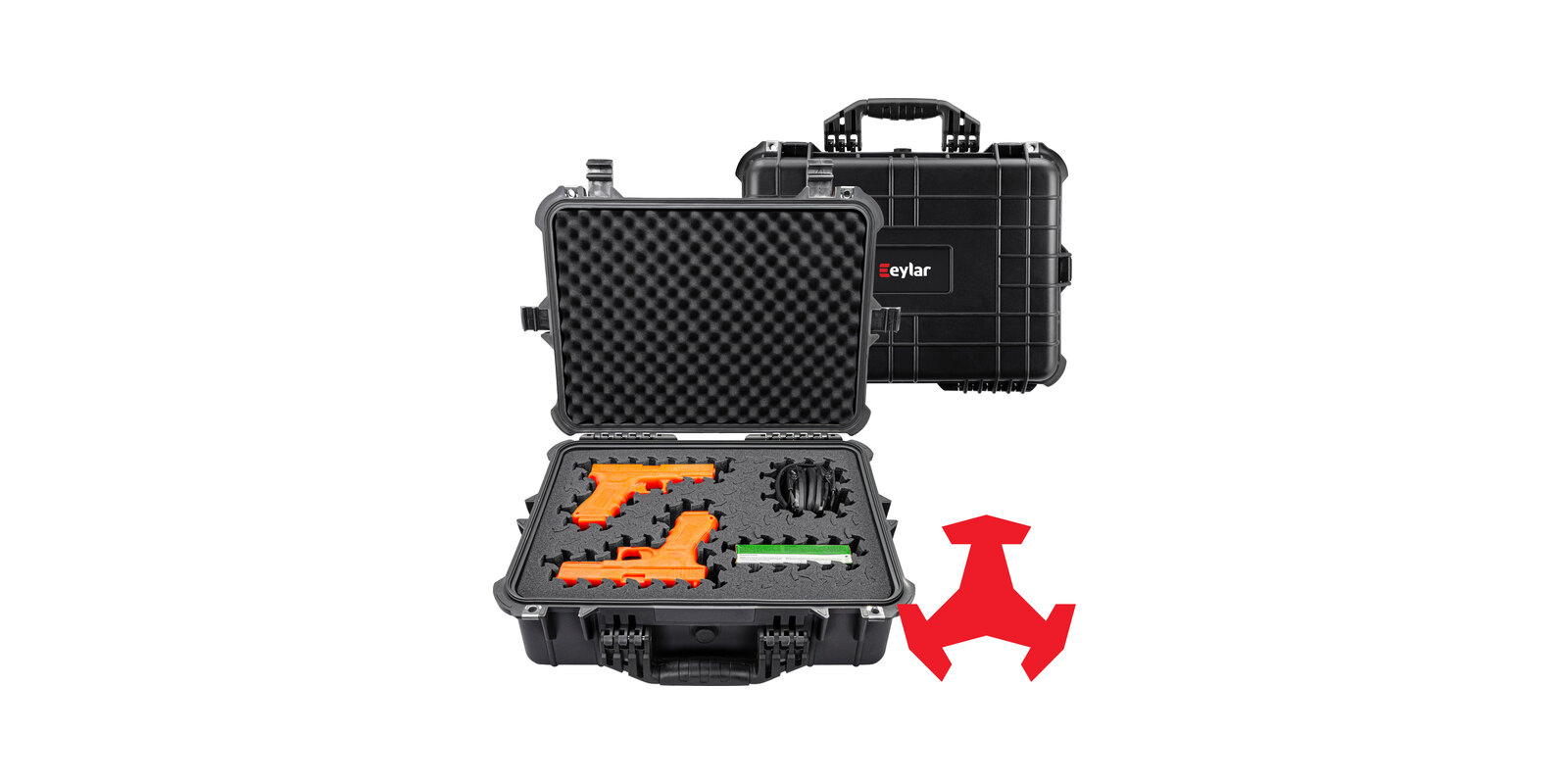
The counterintuitive truth about flying with a firearm: your case needs locks TSA cannot open. Here's how many locks to buy, what shackle size fits, and a step-by-step checklist for the airline counter.
Here is the rule that trips people up at the counter: TSA gun case locks should not be TSA-approved locks. A firearm in checked baggage has to ride in a locked, hard-sided container, and federal rules say only the passenger may keep the key or combination. So you want ordinary keyed or combination padlocks — one in every lock hole.
That is the opposite of the advice you hear for the rest of your luggage. For a suitcase, a TSA master-key lock lets screeners open, inspect and re-lock the bag without cutting anything. For a firearm case, a lock a screener can open alone defeats the point, and a sharp agent will tell you so.
If the firearm you are locking up is a shotgun, see our shotgun cases: hard, lockable and sized by interior length.
Do TSA gun case locks have to be TSA-approved?
No — the opposite. Federal regulations for transporting firearms in checked baggage require the firearm to be unloaded and carried in a locked hard-sided container, and the passenger must be the only person with the means to open it. A TSA master-key padlock can be opened by anyone holding that master key, so it fails the spirit — and in most airlines’ reading, the letter — of that requirement.
What happens in practice: you declare the firearm at the ticket counter, fill out the declaration tag, and the case goes with you or with a TSA officer to a screening area. If screening needs the case opened, you are called back to open it yourself. That is why you stay near the checked-baggage area until your bag clears. Airlines publish their own waiting window; ask the agent how long theirs is.
Keep the master-key locks for the gear that is not a firearm. A set of TSA-accepted 3-digit combination locks is the right call on a camera case, a tool case or a clothing bag, where you would rather have a screener re-lock your case than cut the lock off. On the firearm case, they are the wrong tool.
How many locks does a gun case need?
The honest answer: as many as your case has lock holes. The regulation says “locked,” not “one lock.” But airline agents are trained to look for a container that cannot be pried open at an unlocked corner, and an empty lock hole is exactly what they notice. A 49-inch rifle case with one padlock in the middle and nothing at the ends can be flexed open far enough to get a hand inside. That is a denied bag.
Buy locks by the number of holes, not by the number of guns.
| Case type | Typical lockable points | Locks to buy |
|---|---|---|
| Compact pistol case (10–14 in.) | 2 padlock hasps | 2 |
| Mid-size handgun / range case (16–20 in.) | 2 lockable fittings | 2 |
| Extra-large tactical case (24 in.) | 2 or more lockable fittings | Fill every one |
| Single rifle case (42–49 in.) | 2–4 padlock fittings | Fill every one |
| Long case with 4 corner holes | 4 | 4 |
Carry one spare lock in your carry-on. Locks get lost and keys snap off in cold weather, and a spare costs you nothing but a little space.
What kind of lock actually passes at the counter?
Three things matter, in this order: it fits the hole, it closes fully, and only you can open it.
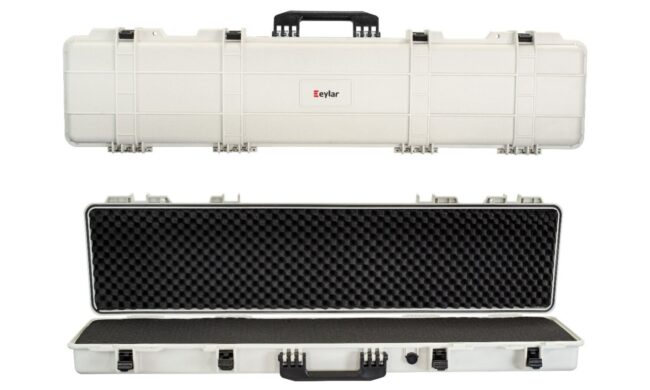
Shackle diameter vs. hasp hole. This is where most online lock purchases go wrong. Hard case lock fittings are molded to a specific size — the Eylar® 49-inch tactical slim rifle case, for example, has two quarter-inch padlock fittings, so you need padlocks with a shackle that passes cleanly through a quarter-inch opening. A thick 3/8-inch shackle off the hardware store wall will not go through, and you will find that out at 5 a.m. Check the spec before you buy.
Shackle clearance. The shackle also needs enough vertical room to clear both halves of the fitting and still click shut. Short-shackle “discus” style locks are tidy and hard to cut, but on some cases they bottom out. Test every lock on the actual case, loaded, at home.
Keyed or combination? Both are legal. The trade-offs are real:
| Lock type | Good for a firearm case? | Watch out for |
|---|---|---|
| Keyed padlock (non-TSA) | Yes | Keys get lost; keep a spare key separate from the case, never inside the bag |
| Combination padlock (non-TSA) | Yes | Set all locks to the same code; dial numbers are hard to read in a dim bag well |
| TSA master-key lock | No | Screeners can open it — fails the “only the passenger” rule |
| Cable lock through the handle | No | Does not secure the lid; the case still opens |
| Zip ties / luggage straps | No | Not a lock; cut in seconds |
My preference for air travel is keyed padlocks, all keyed alike, with one key on my person and a spare in a carry-on pocket. At the counter you are tired, the line is moving, and turning four identical keys is faster than spinning four dials. If you fly with a partner who may need to open the case, combination locks win.
Why do cable locks, zip ties and soft cases get turned away?
A “locked hard-sided container” has to resist being opened without the key. Three common failures:
- Soft cases with a padlock on the zipper. The zipper pulls lock, but the fabric and zipper teeth separate. Many airlines simply will not accept them for firearms.
- Cable or trigger locks used instead of case locks. A cable lock through the action is a fine extra layer, but it does not lock the container. The case itself still has to be locked.
- Latches that flex. Thin plastic latches and shallow hasps can be twisted open. Look for a case with molded-in lockable fittings that engage both halves of the shell, not a lock hole punched through a flap of plastic.
The other quiet failure is fit. If the firearm rattles inside, screeners handle the case more, and a loose gun can shift and bulge a lid. Cut your foam so the gun sits still with the lid closed. Most Eylar hard gun cases ship with three layers — egg-crate lid foam, a pick-and-pluck middle layer and a solid base — and the 20-inch handgun case with RAGAR foam uses lift-out blocks, so you can change the layout when you change pistols or add a red dot. If you need to re-foam an older case, the measuring guide at ragarfoam.com keeps you from ordering the wrong size.
What is the pre-flight checklist before you hand over the case?
Run this the night before, not in the parking lot.
- Unload the firearm. Chamber empty, magazine out, visually and physically checked. No loaded magazines inside the case unless your airline explicitly allows them (most do not).
- Separate the ammunition. Ammo goes in its factory box or a container designed to carry ammunition, with the rounds kept apart. Some airlines allow it inside the same locked hard case; others want it in a separate checked bag. Check your airline’s published weight limit per passenger before you pack.
- No loose ammo, no speed loaders, no magazines rattling in foam pockets unless the airline permits it in writing.
- Count the lock holes and fill all of them with non-TSA padlocks. Same key or same code across all of them.
- Shake test. Close, lock, lift the case by one end, and shake. Nothing moves inside; no corner gaps open.
- Pry test. Pull hard at the midpoint of each long side. If you can see daylight at the gasket, you need another lock or a stiffer case.
- Strip the outside. Remove old airline tags, stickers that advertise the contents, and anything that reads “firearm.” An ID plate with your name is useful; a gun logo is not.
- Put keys on your body. Not in the case, not in the checked bag.
- Arrive early — 30 minutes beyond your normal buffer — and go to a staffed counter. Kiosks cannot process a declaration.
- Declare it verbally, sign the declaration tag, and put the tag inside the case if the agent tells you to (rules differ by carrier; follow their instruction).
- Stay reachable. Keep your phone on and stay near the checked-baggage area until the bag is cleared, in case screening needs you to open it.
- Check destination law before you fly. Federal transport rules do not override state or local rules at the other end.
What makes a case “lockable enough” for the agent to accept?
Agents are not measuring wall thickness. They look at four things: hard sides, a lid that stays shut, lock holes that are filled, and a lock they cannot open themselves.
Practically, that means a molded shell with a gasket, latches that pull the lid down tight, and lockable fittings built into the body rather than bolted on. Two examples from the Eylar line: the 49-inch slim rifle case and the 20-inch handgun case are both IP67 rated and use a pressure-equalization valve, which matters in a cargo hold — pressure swings can make an unvented sealed case hard to open at altitude or after landing.
One more thing worth saying plainly: a lock is a deterrent, not a vault. Baggage handling is rough and theft happens. Four good padlocks on a stiff case, no branding on the outside, and the case checked at a staffed counter rather than curbside is about as much control as you get. If you also want tamper evidence, a thin strip of tape across one latch tells you at the carousel whether anything was opened.
FAQ
Can TSA open my locked gun case?
Not without you. If screening flags your firearm case, TSA is supposed to page you so you can unlock it in front of an officer and re-lock it yourself. That is exactly why your locks must not be master-key locks — and why you should not walk away from the baggage area until your bag has cleared.
How many locks does TSA require on a gun case?
The regulation says the container must be locked; it does not name a number. In practice, use one padlock in every lock hole the case has — two on most pistol cases, up to four on long rifle cases. Leaving holes empty is the most common reason an agent sends a traveler back to the shop.
Can I use my TSA combination locks on a gun case if that is all I have?
Not for the firearm case. Buy non-TSA padlocks sized to your case’s fittings and keep the master-key combination locks for your camera gear, tool case or clothing bag. Carrying both sets is normal for anyone who flies with guns and gear on the same trip.
