
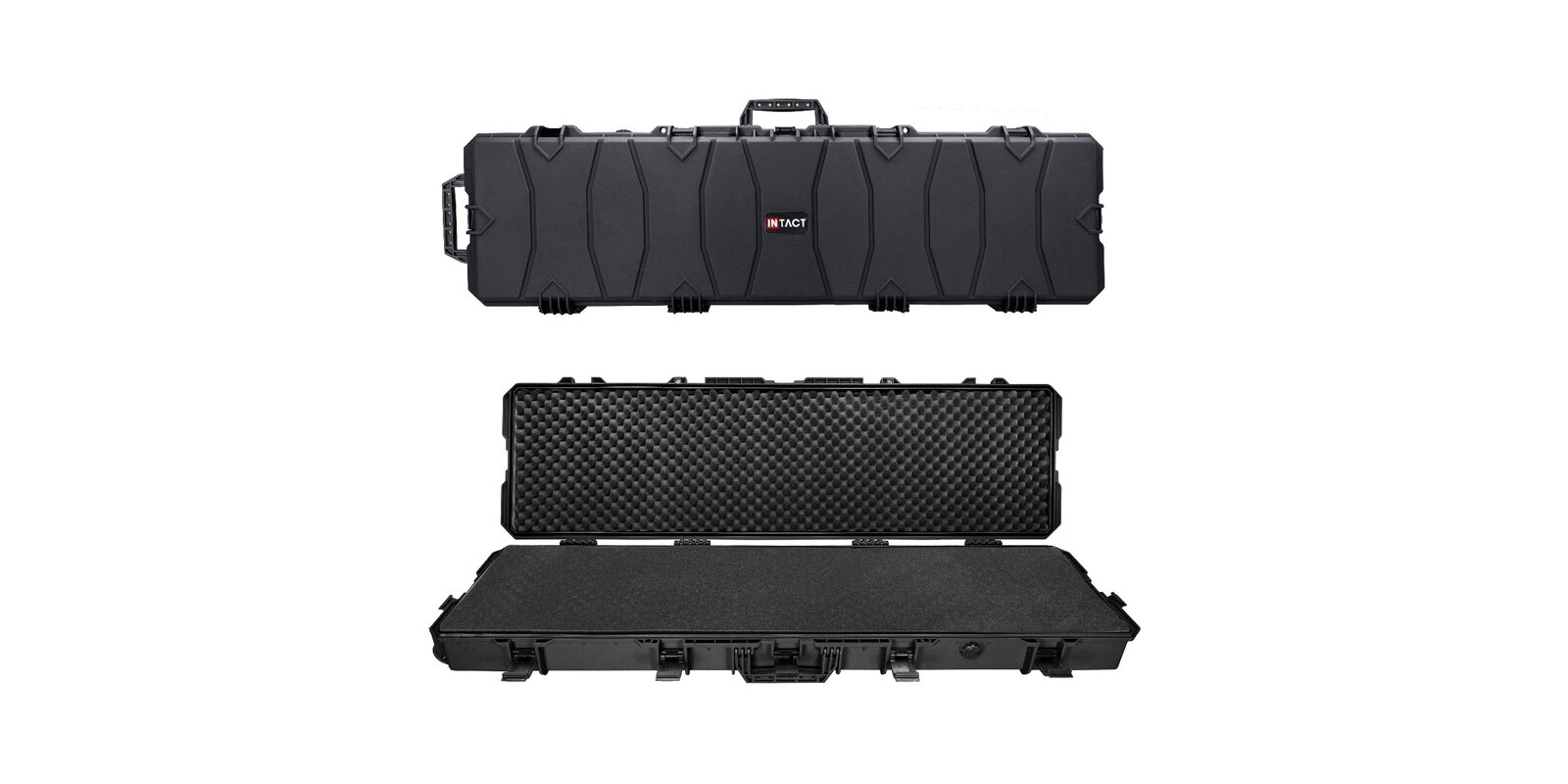
Foam for a gun case comes from three places: the case maker, a fabricator cutting to spec, or a pre-cut drop-in insert. Here's how to pick the right type and thickness, measure your case, and order once.
Foam for a gun case comes from three places: the case manufacturer, a foam fabricator that cuts to your drawing, or a pre-cut drop-in insert sized to a known case model. The quickest route is a drop-in insert made for your case. Custom cutting is for odd shells and suppressed builds.
Where can you buy foam for a gun case?
Almost every search like this ends in one of three places. They are not equal, and the right one depends on whether your case is a known model or a mystery shell you inherited.
The same three options apply to archery: a compound bow case takes the same pluck foam, and the sizing rules below work for a bow and quiver as well as a rifle.
| Source | Best for | What you get | Watch out for |
|---|---|---|---|
| The case manufacturer | You know the brand and model of your case | Foam already cut to the interior dimensions, correct layer count, correct thickness | Only covers that maker’s cases; if your shell is unbranded, measure first |
| A foam fabricator cutting to spec | Odd shells, suppressed rifles, multi-gun layouts, chassis stocks | Any shape you can draw, cut to your dimensions | You supply the drawing and the measurements. Mistakes are yours. Longer lead time. |
| Pre-cut drop-in inserts | Replacing crushed, torn or outgrown foam | Stock sheet sizes that fit common case interiors, trimmed with a straight edge if needed | Sheet size must be equal to or slightly larger than your interior so you can trim down, not pad out |
Eylar® covers the manufacturer and drop-in routes: loose layers through the gun case foam category, reusable modular blocks through RAGAR foam inserts, and complete case and custom foam combos when the shell and the insert should be bought together.
One rule before you order anything: never buy foam smaller than your case interior. A sheet that is a half inch short on each side lets the rifle shift, and shifting is what rubs finish and loosens zero. Buy at or slightly over, then trim.
What types of foam go in a hard gun case?
There are four, and a well-built case uses more than one. They stack from the lid down.
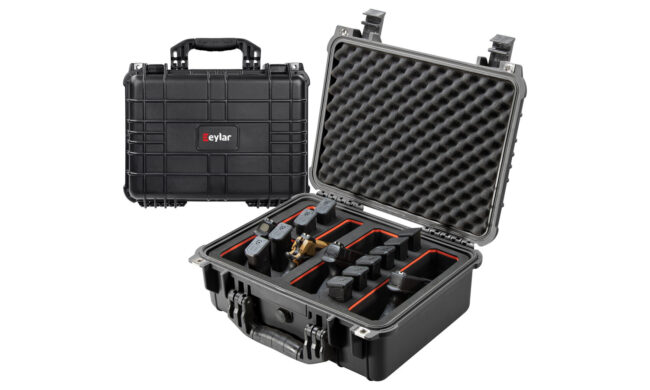
Convoluted (egg-crate) lid foam
The peaks compress against the top of the firearm and hold it down into the base cutout so nothing rattles when the case is handled. It belongs in the lid, not the base — egg crate under a rifle creates pressure points along the stock.
Pick-and-pluck (pull-and-pluck) foam
Pre-scored into small cubes so you can pull a cavity by hand with no knife. This is the DIY layer. Lay the rifle or pistol on top, trace the outline, and pluck cubes inside the line. Leave at least one full cube of wall between neighboring cavities or the divider collapses.
Solid base pad
A plain uncut sheet that sits on the floor of the case. It keeps the plucked layer off the hard shell and absorbs the drop energy that gets through. Skipping the base pad is the most common reason a custom cutout still lets a scope turret contact plastic.
Reusable modular blocks
Instead of destroying foam every time your loadout changes, blocks lift out and go back in. RAGAR is Eylar’s reusable, reconfigurable system, made from XP crosslinked closed-cell foam and covered by U.S. Patent No. 12,358,707. If you change optics, add a can, or swap which guns travel, this is the layer that saves you from re-buying foam every year.
There are also precision-cut inserts built for one job. The 16″ Recon Rack range case uses an EVA foam insert with three removable sections for four handguns plus magazines (U.S. Patent No. D1,097,813), and the Eylar 13.8″ Intact Stacker compact case uses precision-cut polyurethane foam for up to four handguns. Those are the shortcut when your layout is standard.
How thick should gun case foam be?
Thickness is not a guess — it is arithmetic. Your foam stack should total the interior depth of the case, plus a little, so the lid compresses it slightly when latched. If the stack is thinner than the interior, the gun moves. If it is far thicker, the latches strain and the gasket does not seat.
Interior depth is split between the lid and the base. Measure both separately, because they are rarely equal.
| Layer | Job | Sizing rule |
|---|---|---|
| Lid foam (convoluted) | Hold-down pressure | Fill the lid recess; peaks should touch the firearm with the case shut |
| Cut layer(s) | Cradle the firearm | Deep enough that the tallest point — usually the optic or the pistol grip — sits below the top of the foam |
| Base pad (solid) | Impact cushion | Whatever depth remains after the cut layers; never delete it to gain cavity depth |
Real numbers help. The Eylar 48″ Intact Stacker Series rifle case has an interior of 46.46″ x 10.83″ x 3.94″, and it uses convoluted padding top and bottom for a slim, low-profile stack. The 54″ Stacker Series roller has a deeper 51.57″ x 13.19″ x 4.92″ interior and runs four layers — one convoluted, two pull-and-pluck, one solid pad — because the extra depth is there to use. The 39″ Stacker roller goes to five layers in a 37.20″ x 11.61″ x 4.92″ interior.
The pattern: shallow cases get convoluted foam top and bottom; deep cases get a multi-layer stack so you can pluck a cavity and still keep a solid pad underneath.
Density matters as much as thickness. You want closed-cell or crosslinked foam that springs back. Soft open-cell foam feels plush in the store and takes a permanent dent in six months, which is how an “it fit perfectly” cutout turns into a loose one.
How do you measure a case for replacement foam?
Do this before you buy anything. It takes five minutes and saves a return.
- Measure the interior, not the exterior. Case walls are thick and often tapered. The outside dimension can be several inches larger than what actually fits inside.
- Measure at the narrowest point. Hard cases draft inward toward the bottom. Measure length and width at the base of the cavity, not at the lip.
- Measure base depth and lid depth separately. Write both down. Most lids are shallow and only take convoluted foam.
- Note the corner radius. Foam sheets are square; case corners are round. Expect to trim corners, or buy foam already cut for the model.
- Measure the firearm as it travels. Optic mounted, bipod folded, magazine in or out, suppressor on or off. Measure the real configuration, including total height at the tallest point.
- Add clearance. Give the outline about a half inch of foam on every side of the firearm so the walls can compress instead of tearing.
- Check for internal obstructions. Hinge bosses, latch ribs and wheel wells eat interior space. Account for them before cutting.
If you want the long version with diagrams, the step-by-step on how to measure a case for replacement foam walks through each measurement and the common errors.
Why not just use upholstery or packing foam?
Because it is the wrong material doing a job it was never designed for. Three failures show up over and over:
- Compression set. Open-cell upholstery foam flattens under sustained load. After a season in a closed case, the cutout no longer grips, and the foam that used to cushion a drop is now a thin pancake.
- Moisture retention. Open-cell foam acts like a sponge. It holds humidity against bare metal in a sealed case — exactly the condition that starts rust. Closed-cell foam does not wick water the same way.
- Unknown chemistry. Craft and furniture foams and their adhesives are not chosen with gun finishes in mind, and long storage against a coated stock or a blued barrel is not what they were made for. Foam built for cases is.
Packing foam from a shipping store has the opposite problem — it is often too stiff and shatters into crumbs after a few open-and-close cycles. You end up with foam dust in the action.
Should you buy foam alone or a case-and-foam combo?
Buy foam alone when the shell is sound: latches lock, the gasket is intact, the hinge is tight, and only the foam is crushed or outgrown. That is a straightforward foam purchase.
Buy a combo when any of these are true:
- The case does not seal anymore, or the latches have cracked.
- The interior is too small for your current build — you are trying to solve a length problem with foam, and foam cannot add inches.
- You need travel features the old case lacks, such as padlock-adaptable fittings for airline checked baggage or a pressure-equalization valve.
- You want a layout you can rearrange later instead of a one-time cutout.
Combos also remove the sizing risk. The Eylar Skull Pizza hard roller rifle case ships with three layers — one RAGAR reconfigurable pad, one solid layer and one egg-crate pad — in an IP67 waterproof shell with two padlock-adaptable fittings. The Tactical Skull roller pairs the same reusable foam system with an IP67 body. For a simple pistol setup, the 11.7″ Intact Stacker handgun case uses convoluted padding top and bottom in an 11.61″ x 8.46″ x 3.15″ interior.
Eylar is based in Pomona, California, ships free in the US and takes returns within 30 days, so a sizing mistake is not permanent.
FAQ
Can I cut pick-and-pluck foam without a knife?
Yes — that is the point of it. The sheet is pre-scored into cubes. Trace your firearm’s outline on the foam, then pull the cubes inside the line by hand, one at a time. Work down one layer at a time and test-fit often; you can remove foam but you cannot put it back. Leave a full cube of material between separate cavities so the walls stay stiff.
What foam is best if my loadout keeps changing?
Reusable modular blocks. Plucked foam is a one-time commitment — change optics or add a suppressor and the cutout is wrong for good. A reconfigurable system like RAGAR lets blocks lift out and go back in, so the same insert can hold a rifle this month and a two-pistol range layout next month. RAGAR inserts are also sold at ragarfoam.com.
How much foam should sit under the firearm?
Enough that the gun never touches the plastic shell, with cushion to spare. Keep a solid base pad below the cut layer rather than plucking all the way to the floor of the case. Drops land on the bottom corners, and that uncut pad is what spreads the hit instead of transmitting it straight into the receiver or scope.
