
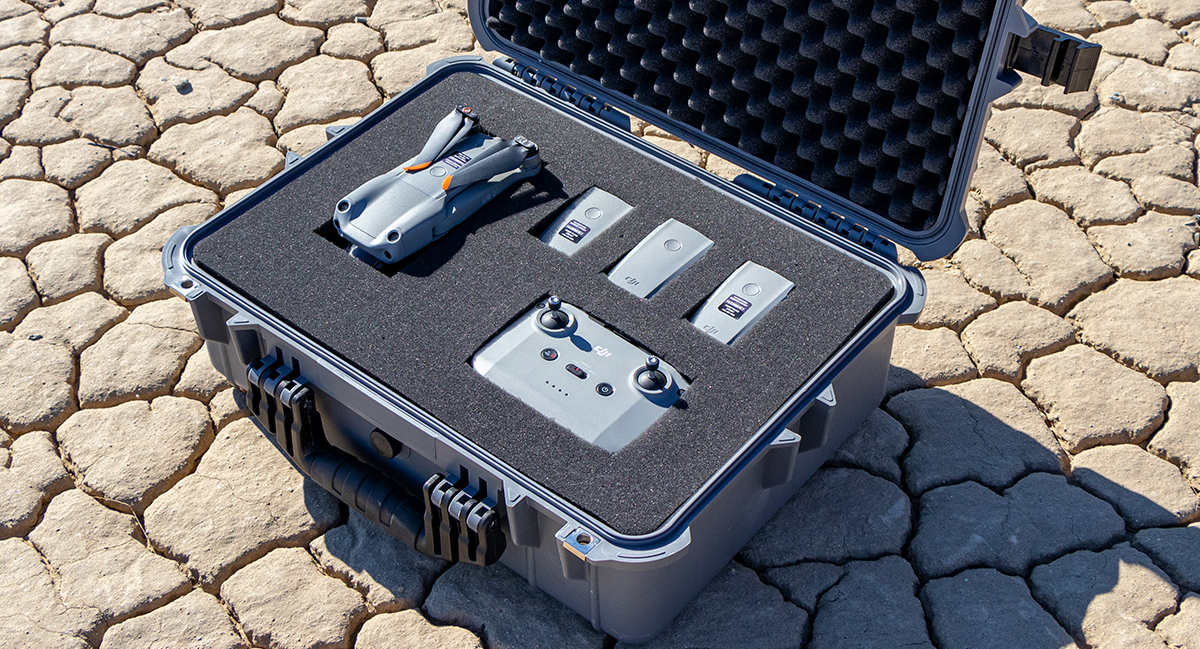
How to choose a hard drone case by interior size, cut foam so the drone can't shift, and pack it for camping, road trips and air travel.
A hard drone case is a rigid, sealed box with foam inside that keeps your drone, controller, batteries and props from being crushed or soaked. Size it by interior dimensions, not by drone name: measure the folded drone plus accessories, add about half an inch of foam per side, and match that to the case interior.
What does a hard drone case actually protect against?
Drones fail on the ground more often than in the air. A gimbal that rattles against a zipper, a bent prop arm in a trunk, grit in the motor bells after a beach day — none of that happens in flight. A rigid case with cut foam removes the movement that causes it.
Multi-drone operators and crews with a controller, monitor and battery bank usually step up to a large hard case with wheels rather than carrying two compact cases.

The Eylar® Intact Series compact cases are built from reinforced high-pressure polypropylene and rated IP67 for waterproof and dustproof protection, with a shell built to take impact. That matters more for drones than for most gear, because a drone is a mix of optics, small motors and exposed electronics in one airframe.
Three things do the real work:
- The shell. Takes the drop, the stacked duffel bag, the tailgate slam.
- The seal. A gasket keeps out rain, dust, river spray and the fine sand that finds its way into everything on a camping trip.
- The foam. Stops the drone from moving inside the shell. A hard case with loose foam is just a louder soft bag.
Eylar’s compact cases also use a stacker design, so they stack securely with other Intact Stacker Series cases. If you carry a drone case plus a battery or accessory case, they travel as one block instead of sliding around the back of a vehicle.
What size hard drone case do you need?
This is where most people get it wrong. External dimensions are what you see on the box, but foam lives inside the internal dimensions. Always size from the inside out.
Measure your kit like this:
- Fold the drone exactly the way you’ll store it. Arms in, gimbal cover on.
- Measure its length, width and height at the widest points.
- Lay out everything else you’ll carry: controller, batteries, charger, cables, spare props, ND filters, memory cards, landing pad.
- Group those items into a rough rectangle beside the drone and measure that block.
- Add 1 inch to length and width (half an inch of foam wall on each side), and leave a little extra height so lid foam can press down on the top.
Then compare with the internal dimensions below.
| Model | Internal size | External size | Weight | Good for |
|---|---|---|---|---|
| Eylar 11.8″ Intact Series Compact | 10.24″ x 7.48″ x 4.53″ | 11.81″ x 9.25″ x 5.11″ | 2.75 lb | A small folding drone, controller and 2–3 batteries |
| Eylar 13.8″ Intact Series Compact | 12.20″ x 9.45″ x 5.71″ | 13.78″ x 11.42″ x 5.91″ | 5 lb | A larger folded drone plus controller, batteries, charger and spare props |
If your measured block is within about a quarter inch of an interior dimension, size up. Foam needs room to compress; a case packed to the millimeter puts pressure on the drone every time the lid closes.
Those two sizes are the 11.8″ Intact Series compact case and the roomier 13.8″ Intact Series compact case, and both ship with foam already inside.
How do you cut the foam to fit a drone?
The Intact Series cases come with four layers of foam: one convoluted (egg-crate) layer for the lid, two pull-and-pluck layers, and one solid base pad. That combination is built for exactly this job — you pluck a cavity, the base pad protects from below, and the lid foam presses down from above.
Cutting a clean drone cavity:
- Leave the solid base pad alone. It’s your shock floor.
- Place the folded drone on the pull-and-pluck layer and trace its outline with a pen or marker.
- Stay one cube inside your traced line. Foam gives; a cavity cut to the exact outline ends up loose.
- Pull cubes from the top layer only for the drone’s body, then go a layer deeper if the drone is taller than one sheet.
- Cut separate pockets for the controller and batteries so nothing can slide into the gimbal.
- Close the lid. If you can shake the case and hear or feel any movement, the cavity is too big — push a plucked cube back in as a shim.
If you’d rather not pluck at all, or you expect to change drones, read how to measure a case for replacement foam first, then consider RAGAR — Eylar’s reusable, reconfigurable foam made from XP crosslinked closed-cell blocks. Blocks lift out and go back in, so one insert can hold a drone this season and a different layout next season. RAGAR is covered by U.S. Patent No. 12,358,707, and there are drone-ready options in the RAGAR camera and drone case lineup.
Can you fly with a drone in a hard case?
Yes, and a sealed hard case makes it easier, not harder. Most Eylar hard cases use lockable hasps with TSA-approved fittings, so you can lock the case and screeners can still open it if they need to, and models built for air travel add an automatic pressure-equalization valve that lets the case breathe as cargo-hold pressure changes. Both features vary by model, so check the specs on the product page before you book.
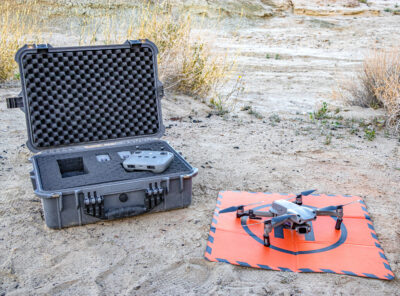
The part that trips people up is batteries, not the drone. In general terms, airlines treat drone lithium batteries like any other spare lithium battery:
- Spare batteries go in carry-on, never in checked bags.
- Terminals must be protected — use a battery bag, tape over the contacts, or individual sleeves.
- Many carriers want batteries at storage charge rather than fully charged.
- Watt-hour limits and battery counts vary by airline and country. Check your specific airline before you leave for the airport.
A practical setup: batteries and the controller in a small case that goes in your carry-on, the airframe in a hard case that stays closed and locked from curbside to baggage claim. Add a luggage tag or one of Eylar’s custom laser-engraved ID plates so a checked case is easy to identify.
How should you pack a drone case for camping and road trips?
Field conditions punish gear differently than airports do. Heat, humidity, dust and vibration from washboard roads are the usual suspects.
Pre-trip checklist:
- Gimbal cover on and locked before the drone goes in the foam.
- Props either folded flat or removed and stored in their own pocket.
- Batteries at storage charge if the trip runs longer than a few days.
- One spare set of props, one spare set of sticks, and a microfiber cloth in the case.
- Memory cards in a hard card wallet, not loose in the foam.
- Latches closed and padlocks fitted — the standard padlock mounting points take small travel locks.
- Case stored out of direct sun. A closed case in a locked car gets hot fast, and heat is harder on lithium batteries than cold.
- After a dusty or wet day, wipe the gasket before closing the lid. Grit on the seal is the fastest way to lose a waterproof rating.
Because the Intact Series cases stack, a drone case and a battery case ride together in a truck bed or a camp locker instead of sliding apart. The center handle keeps a loaded case balanced on the walk in from the trailhead.
Which hard drone case setup should you choose?
| Your situation | What to pick |
|---|---|
| One small folding drone, minimal accessories | 11.8″ Intact Series — lightest to carry at 2.75 lb |
| Drone plus controller, charger, 3+ batteries, filters | 13.8″ Intact Series — 12.20″ x 9.45″ x 5.71″ inside |
| You change drones or gear often | A case with a RAGAR insert so the layout can be rebuilt |
| Frequent air travel | An IP67 case with TSA-approved fittings and a pressure valve, locked |
| Mixed kit across several cases | Stacker Series cases so everything travels as one block |
You can compare full configurations on the Eylar drone case page, and the broader camera hard case category covers larger kits if you carry a drone alongside a camera body and lenses. Eylar is based in Pomona, California, and orders ship free in the US with 30-day returns, so you can do a fit check with the case in hand.
FAQ
Is a hard drone case better than the soft bag that came with my drone?
For storage at home, a soft bag is fine. For transport, a hard case wins on three counts: it resists crushing, it seals against water and dust with an IP67 rating, and the foam holds the airframe still. Soft bags let the gimbal and arms move, and movement is what breaks drones in transit.
How much extra room should I leave around the drone in the foam?
About half an inch of foam on each side, plus a little compression from the lid foam. Cut the cavity one cube inside your traced outline so the foam grips the airframe. If the drone drops into the pocket with no resistance, the cavity is too large and the drone will shift.
Can I reuse the same case if I upgrade to a bigger drone?
Only if the new airframe fits the internal dimensions. Pull-and-pluck foam can’t be un-plucked, so a size change usually means new foam. A reconfigurable RAGAR insert solves that — blocks lift out and go back, so you rebuild the layout instead of buying another case.
